

Book guide and evaluation
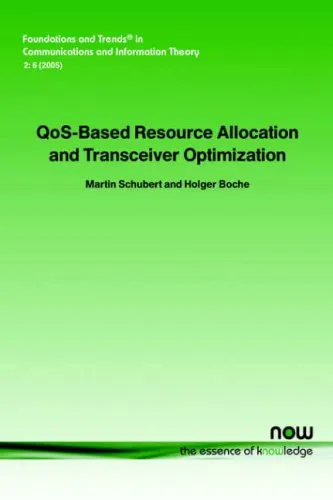
QoS-Based Resource Allocation and Transceiver Optimization (Foundations and Trends in Communications and Information Theory)
Martin Schubert,Holger Boche
English
Beginner
Engineering
4.7 / 5
0 reviews
2006
Published
163
pages
142
views
Introduction to 'QoS-Based Resource Allocation and Transceiver Optimization' The book 'QoS-Based Resource Allocation and Transceiver Optimization', authored by Martin Schubert and Holger Boche, serves as a cornerstone in understanding modern communications systems, parti
Before you read
What will you get from this book?
Introduction to 'QoS-Based Resource Allocation and Transceiver Optimization'
The book 'QoS-Based Resource Allocation and Transceiver Optimization', authored by Martin Schubert and Holger Boche, serves as a cornerstone in understanding modern communications systems, particularly within the context of resource management and optimization with Quality of Service (QoS) constraints. As part of the Foundations and Trends in Communications and Information Theory series, this book blends rigorous theoretical analysis with practical relevance. It is meticulously crafted to bridge the gap between academic research and industry implementation, empowering professionals and researchers to build efficient and optimized communication systems. This introduction aims to provide insight into what the book offers, its structure, and its enduring relevance in the evolving landscape of wireless communication and signal processing.
Detailed Summary of the Book
With the rapid proliferation of high-speed wireless networks and multimedia applications, ensuring efficient resource allocation while maintaining high levels of Quality of Service has become paramount. This book delves into the mathematical frameworks and optimization techniques required to address these challenges. The key subject areas covered include:
- Mathematical foundations of optimization and convex analysis for resource allocation.
- Advanced techniques in beamforming and signal processing for transceiver optimization.
- Algorithmic approaches to QoS-constrained resource management in multi-user and multi-antenna systems.
- Practical perspectives on interference management and multi-cell coordination in modern networks.
The book provides a systematic exposition of QoS principles and their integration into resource allocation. Additionally, a variety of real-world network scenarios are analyzed, making it a comprehensive guide for academics, researchers, and engineers.
Key Takeaways
Whether you are a graduate student aiming to solidify your knowledge or a professional seeking insight into cutting-edge communication systems, this book offers a range of takeaways:
- An in-depth exploration of the intersection between resource allocation and signal processing.
- A deep dive into convex optimization principles and their application in communication systems.
- Detailed analysis and implementation of QoS constraints in real-world networks.
- Practical algorithms and methodologies for interference management and network design.
- Broad coverage of multi-user, multi-cell, and multi-antenna communication systems.
Famous Quotes from the Book
The insights from this book are not only technical but also thought-provoking. Some notable excerpts include:
"Optimization is not merely a mathematical endeavor; it is the backbone of effective decision-making in communications."
"Quality of Service is the silent agreement between the network and its users, ensuring reliability in an unpredictable world."
"In the era of ubiquitous connectivity, efficient resource allocation is both a challenge and a necessity."
Why This Book Matters
The importance of this book lies in its ability to address the ever-growing demands on modern communication networks. In an age where data-driven services and multimedia applications dominate, ensuring high QoS requires unparalleled resource optimization. This book is especially relevant for the following reasons:
- It provides a comprehensive theoretical framework for understanding resource allocation in complex network scenarios.
- It combines theoretical rigor with practical applications, making it accessible to both researchers and industry professionals.
- It equips readers with the tools needed to navigate emerging technologies, such as 5G and beyond, where QoS requirements are even more stringent.
- It has a strong focus on multi-user and multi-antenna systems, which are foundational to modern communication infrastructure.
Ultimately, this book is a testament to the indispensable role of optimization in driving the future of wireless communications. With its detailed discussions, practical insights, and mathematical precision, it stands as a definitive guide for anyone passionate about shaping the future of connectivity.
Ask this book
Your question is answered in the context of this title and author. Each answer uses 2 points.
Sign in to ask the book assistant.
Reader reviews
0 reviews, 4.7 average out of 5
No reviews yet
If you have read this book, help the next reader with your experience.
Write a review
Sign in to publish a review.
Reader questions and answers
Ask a focused question and learn from the community.
Sign in to ask or answer a question.
No questions yet
Be the first to ask a clear, useful question.
What to read next
Related references that continue this learning path.


Modern Computer Vision with PyTorch: A Practical Roadmap From Deep Learning Fundamentals to Advanced Applications and Generative AI, 2nd Edition
V Kishore Ayyadevara,Yeshwanth Reddy
2023
View book