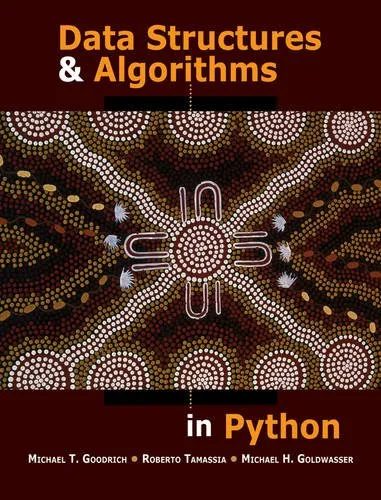
Data Structures and Algorithms in Python
Michael T. Goodrich,Roberto Tamassia,Michael H. Goldwasser
2013
View book

Book guide and evaluation
Mark Summerfield
0 reviews
Published
pages
views
Introduction Welcome to Python in Practice: Create Better Programs Using Concurrency, Libraries, and Patterns, a book dedicated to helping Python developers refine their coding skills, improve software performance, and create more robust and maintainable applic
Before you read
Welcome to Python in Practice: Create Better Programs Using Concurrency, Libraries, and Patterns, a book dedicated to helping Python developers refine their coding skills, improve software performance, and create more robust and maintainable applications. Designed for intermediate to advanced Python practitioners, this book bridges the gap between theoretical programming concepts and real-world application design.
Through this work, I aim to provide a practical guide to taking full advantage of Python's capabilities, equipping readers with foundational practices to write better programs. Whether you're looking to dive into concurrency, harness powerful Python libraries, or implement proven design patterns, this book will serve as your roadmap to becoming a more effective and confident Python developer.
At its core, Python in Practice focuses on three major topics: concurrency, libraries, and design patterns.
In the first section, the book delves into the essentials of concurrency, offering practical explanations of threads, multiprocessing, and asynchronous programming. These are crucial in writing applications that are not only efficient but also responsive. By using real-world examples, readers explore how to properly manage concurrent tasks while avoiding common pitfalls such as race conditions and deadlocks.
The second part emphasizes Python's vast standard library and third-party libraries, showcasing how they can be leveraged to solve a range of programming challenges elegantly. From file operations and data serialization to advanced data manipulation with NumPy or Pandas, this section demonstrates how libraries play an indispensable role in simplifying complex programming tasks.
The third segment introduces design patterns and their integration with Python’s idiomatic style. While design patterns originated in other programming paradigms, the book reinterprets these patterns specifically for Python, ensuring they remain intuitive and Pythonic. Patterns such as Singleton, Factory, and Decorator are explained in depth with practical, applicable code examples.
The book is rich with concise code snippets, yet every example serves a purpose. Each topic ties seamlessly into the next, ensuring a logical and structured flow that reinforces learning. By the conclusion, readers will have gained a well-rounded understanding of how to create Python programs that excel in performance, scalability, and maintainability.
"Concurrency is not inherently about speed; it is about managing multiple streams of operations without compromising responsiveness or correctness."
"Libraries are the heartbeat of Python. They empower every developer to move from reinventing the wheel to building sophisticated solutions atop proven foundations."
"Good design patterns are timeless; they provide a common vocabulary for developers and serve as blueprints for solving recurring software challenges."
Python in Practice matters because it addresses the natural evolution of a Python developer's journey—from writing basic scripts to crafting professional-grade applications. The tools and techniques outlined in this book are directly applicable to the growing demands of modern software development.
For programmers seeking to dive deeper into Python’s advanced topics, this book serves as a solid foundation. It explains not just the "how" but also the "why" behind concepts such as concurrency and design patterns. By focusing on code quality and sustainability, readers learn how to future-proof their programs, ensuring they remain maintainable and performant over time.
In an ever-evolving tech landscape, where efficiency and maintainability are paramount, this book helps Python developers stand out. It encourages readers to write software that doesn’t just work but works well, aligning with best practices and maintaining an emphasis on clarity, stability, and performance.
In summary, Python in Practice: Create Better Programs Using Concurrency, Libraries, and Patterns is not just about improving your Python skills; it’s about developing a mindset that fosters innovation and excellence in software development.
Your question is answered in the context of this title and author. Each answer uses 2 points.
0 reviews, 4.0 average out of 5
Sign in to publish a review.
Ask a focused question and learn from the community.
Related references that continue this learning path.
Michael T. Goodrich,Roberto Tamassia,Michael H. Goldwasser