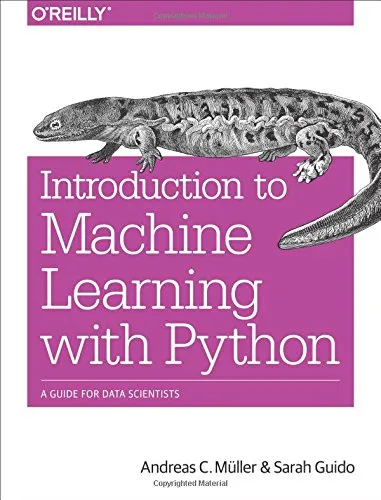
Introduction to Machine Learning with Python: A Guide for Data Scientists
Andreas C. Müller,Sarah Guido
2016
View book
Book guide and evaluation
Ajay Ohri
0 reviews
Published
pages
views
Introduction to 'Python for R Users' Welcome to the transformative journey from R to Python! In a world where data science and analysis dominate the scene, proficiency in multiple tools can give your career the edge it deserves. 'Python for R Users' is crafted meticulously
Before you read
Welcome to the transformative journey from R to Python! In a world where data science and analysis dominate the scene, proficiency in multiple tools can give your career the edge it deserves. 'Python for R Users' is crafted meticulously to help R users leverage their existing knowledge and dive smoothly into the world of Python—a language revered for its readability, versatility, and extensive libraries.
The book 'Python for R Users' acts as a bridge for those already familiar with R programming. It is designed to elevate their skill set by introducing Python in a user-friendly and intuitive manner. It starts with the basics of Python, ensuring a solid foundation before venturing into more complex topics such as data manipulation, statistical modeling, and machine learning. Understanding how Python can enhance data analysis, with comparisons drawn to what the user already knows in R, offers a holistic learning experience.
The text delves deep into Python packages equivalent to R's popular packages. For instance, it covers Pandas for data manipulation akin to dplyr in R, Matplotlib for data visualization as one might use ggplot2, and Scikit-learn for machine learning, mirroring R's caret. Each chapter is structured to build seamlessly upon the last, ensuring that learning is cumulative.
Interspersed with practical examples and exercises, you will find this book not only informative but also interactive. By the end of this journey, readers will have a dual-tool capability, able to switch between R and Python with ease, and know when to leverage each language's strengths in their data science workflows.
"Transitioning from R to Python is not about abandoning your roots—it's about broadening your horizons."
"Python for R Users is about synergy, not competition, between two powerful tools in a data scientist’s toolkit."
In an ever-evolving field like data science, versatility is key. 'Python for R Users' equips readers with the flexibility to operate confidently in both languages, enhancing employability and broadening career prospects. The strategic insight offered into when and where each language excels allows for more efficient problem solving and innovation in data projects.
Furthermore, as Python’s community and ecosystem continue to burgeon, understanding Python alongside R ensures that readers are future-proofing their skills. The book’s relevance is only augmented by the trend of cross-language integrations in modern data science environments, making dual proficiency a highly valued asset.
Your question is answered in the context of this title and author. Each answer uses 2 points.
0 reviews, 4.0 average out of 5
Sign in to publish a review.
Ask a focused question and learn from the community.
Related references that continue this learning path.
Andreas C. Müller,Sarah Guido