Book guide and evaluation
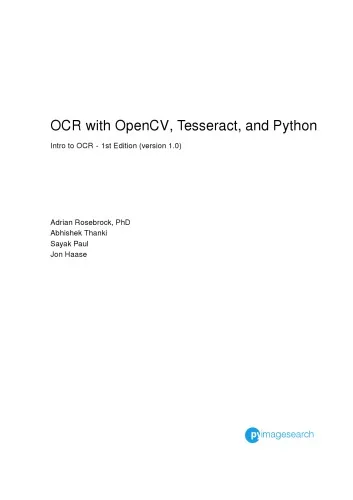
PyImageSearch OCR
Adrian Rosebrock
English
Unordered
Artificial Intelligence (AI)
4.7 / 5
0 reviews
2021
Published
218
pages
216
views
PyImageSearch OCR Optical Character Recognition, Computer Vision PyImageSearch OCR empowers readers to master text extraction using computer vision and OCR techniques. Analytical Summary PyImageSearch OCR is a technical yet highly accessible guide that explores th
Before you read
What will you get from this book?
Analytical Summary
PyImageSearch OCR is a technical yet highly accessible guide that explores the fusion of Optical Character Recognition with advanced computer vision workflows. Authored by Adrian Rosebrock, this book provides a structured pathway for professionals, academics, and motivated learners to harness the power of text extraction from images and scanned documents.
The book systematically dissects the theoretical underpinnings of OCR technologies, explains their historical evolution, and offers practical, code-driven examples to solidify understanding. Readers are taken from fundamental image preprocessing techniques through to highly optimized recognition pipelines that can be adapted for diverse applications, from archival document digitization to real-time license plate recognition.
Unique to PyImageSearch OCR is its balanced approach—deep enough to satisfy academic rigor, yet pragmatic in its provision of fully working scripts and reproducible experiments. While some texts remain abstract, this volume thrives on applicable insights, enabling the reader to bridge the gap between concept and deployment.
Key Takeaways
In reading PyImageSearch OCR, the audience will gain actionable knowledge to build, fine-tune, and deploy high-performing OCR systems tailored to specific needs.
Firstly, you will learn the essential preprocessing steps—such as noise reduction, thresholding, and contour detection—that significantly increase OCR accuracy. Secondly, the book emphasizes selecting the right OCR engine for your use case, including open-source solutions and their optimal configurations. Thirdly, the reader acquires skills in integrating OCR output into broader analytical frameworks, enabling deeper data-driven decision-making.
Additionally, PyImageSearch OCR underscores the importance of evaluation metrics, instructing you on how to measure precision, recall, and overall system robustness. Finally, it explores emerging trends, such as deep learning enhancements to OCR, giving readers a future-facing perspective.
Memorable Quotes
OCR is not merely about reading text—it's about unlocking information trapped in visual formats. Unknown
In computer vision, clarity begins with preprocessing, and OCR is no exception. Unknown
PyImageSearch OCR bridges the gap between research papers and deployable solutions. Unknown
Why This Book Matters
Accuracy in OCR results translates directly into the integrity of downstream analytical tasks. PyImageSearch OCR equips readers with the tools and rationale to achieve that accuracy consistently.
In today's data-driven landscape, the ability to transform static visual data into searchable, structured formats is a competitive advantage. This book empowers professionals to implement OCR within scientific projects, business automation, and accessibility solutions—widely recognized as high-impact areas across industries.
Information about the original publication year is unavailable, due to no reliable public source documenting its release date. However, the principles and techniques within remain relevant and forward-looking, aligning with the continuing advancement of OCR technologies.
Inspiring Conclusion
PyImageSearch OCR stands as both a technical manual and an invitation to innovate. It gives readers the power to convert the written world embedded in images into actionable data, bridging the analog and digital domains.
By deliberately combining Optical Character Recognition principles with hands-on Python-guided implementations, this volume opens the door to countless applications—be it academic research, enterprise automation, or personal projects. The accessibility of the explanations ensures that even challenging techniques become approachable, while the depth of coverage satisfies the most demanding experts.
If you seek to master the art and science of OCR, embrace the knowledge within PyImageSearch OCR. Read it, share your insights, and discuss its teachings with peers. Your next breakthrough in computer vision may very well begin here.
Ask this book
Your question is answered in the context of this title and author. Each answer uses 2 points.
Sign in to ask the book assistant.
Reader reviews
0 reviews, 4.7 average out of 5
No reviews yet
If you have read this book, help the next reader with your experience.
Write a review
Sign in to publish a review.
Reader questions and answers
Ask a focused question and learn from the community.
Sign in to ask or answer a question.
No questions yet
Be the first to ask a clear, useful question.
What to read next
Related references that continue this learning path.
Pro Deep Learning with TensorFlow: A Mathematical Approach to Advanced Artificial Intelligence in Python
Santanu Pattanayak (auth.)
2017
View book