

Book guide and evaluation
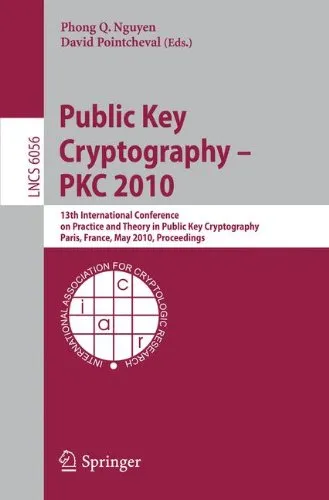
Public Key Cryptography – PKC 2010: 13th International Conference on Practice and Theory in Public Key Cryptography, Paris, France, May 26-28, 2010. Proceedings
Kristiyan Haralambiev,Tibor Jager,Eike Kiltz,Victor Shoup (auth.),Phong Q. Nguyen,David Pointcheval (eds.)
English
Beginner
Art
4.3 / 5
0 reviews
2010
Published
530
pages
116
views
Introduction to "Public Key Cryptography – PKC 2010" Welcome to the proceedings of the "13th International Conference on Practice and Theory in Public Key Cryptography (PKC 2010)", held in Paris, France, from May 26-28, 2010. This book encapsulates the significant advancem
Before you read
What will you get from this book?
Introduction to "Public Key Cryptography – PKC 2010"
Welcome to the proceedings of the "13th International Conference on Practice and Theory in Public Key Cryptography (PKC 2010)", held in Paris, France, from May 26-28, 2010. This book encapsulates the significant advancements and discussions from the conference, exploring foundational theories and applied research in public key cryptography. It represents the convergence of academia and industry in developing secure and scalable cryptographic solutions, making it a valuable read for scholars, practitioners, and students alike.
Public key cryptography has been the cornerstone of secure digital communication for decades. It has paved the way for innovations in encryption, authentication, and privacy in the digital age. PKC 2010 includes cutting-edge research addressing the challenges faced by modern cryptographic systems, focusing on enhancing security, performance, and practicality. This book not only presents novel contributions from esteemed researchers but also offers a comprehensive overview of contemporary trends in public key cryptography.
Detailed Summary of the Book
"Public Key Cryptography – PKC 2010" comprises 34 meticulously reviewed papers that were presented during the conference. These papers were carefully selected from over 140 submissions, ensuring that only the most substantial and impactful research contributions were included. This rigorous selection process demonstrates the high academic standards maintained throughout the PKC series.
The topics covered in PKC 2010 span both theoretical aspects and practical implementations of public key cryptography. Core areas include but are not limited to key exchange protocols, cryptographic primitives, identity-based encryption, lattice-based cryptography, signature schemes, and secure multi-party computations. Each chapter delves deeply into specific challenges and solutions, often introducing new cryptographic constructions or improving upon existing ones.
Additionally, several proposals focus on combating emerging threats, such as advancements in quantum computing and their potential to undermine traditional cryptographic algorithms. The book's emphasis on both timeless cryptographic principles and contemporary challenges ensures its relevance for years to come.
Key Takeaways
- Comprehensive coverage of both theoretical and practical aspects of public key cryptography, ensuring a holistic understanding of the field.
- Insights into the latest research on cryptographic primitives, protocols, and post-quantum cryptography.
- A rigorous academic approach, showcasing over 30 peer-reviewed papers from distinguished researchers.
- A balanced focus on foundational cryptographic principles and their real-world applications.
- Discussions on novel cryptographic methods that address pressing security issues of today and tomorrow.
Famous Quotes from the Book
While this book is primarily academic in nature and does not feature standalone quotes as seen in literary works, several key ideas from the presented papers resonate deeply:
"The power of cryptography lies not only in securing information but in enabling trust across inherently insecure networks."
"Quantum threats demand quantum readiness—future cryptographic protocols must adapt to unforeseen computational capabilities."
"Practical usability and theoretical rigor must converge to foster the adoption of secure systems in a rapidly evolving digital landscape."
Why This Book Matters
The significance of this book lies in its ability to bridge the gap between theoretical advancements and practical applications in cryptographic research. Its focus on the duality of practice and theory ensures that the results presented are not only mathematically sound but also feasible and applicable in real-world scenarios. As the reliance on secure communication grows in sectors like finance, healthcare, and government, contributions like these are instrumental in safeguarding sensitive data and ensuring data veracity.
With the advent of quantum computing and evolving cyber threats, the cryptographic community is at a critical juncture. The proceedings of PKC 2010 serve as a timely resource for anyone aiming to navigate this complexity. It highlights future directions, equips readers with the latest cryptographic tools, and challenges them to build on these foundations to tackle upcoming security problems.
Whether you are an academic researcher delving into cryptographic theories or a security practitioner seeking cutting-edge techniques, this book is a treasure trove of insights. It underscores the importance of collaborative progress within the cryptographic community and fosters innovation in the development of secure digital ecosystems.
Ask this book
Your question is answered in the context of this title and author. Each answer uses 2 points.
Sign in to ask the book assistant.
Reader reviews
0 reviews, 4.3 average out of 5
No reviews yet
If you have read this book, help the next reader with your experience.
Write a review
Sign in to publish a review.
Reader questions and answers
Ask a focused question and learn from the community.
Sign in to ask or answer a question.
No questions yet
Be the first to ask a clear, useful question.
What to read next
Related references that continue this learning path.


Modern Computer Vision with PyTorch: A Practical Roadmap From Deep Learning Fundamentals to Advanced Applications and Generative AI, 2nd Edition
V Kishore Ayyadevara,Yeshwanth Reddy
2023
View book