
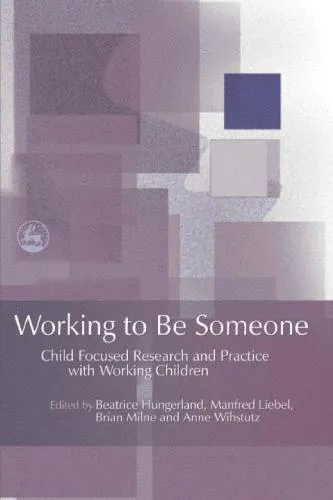
Working to be someone : child focused research and practice with working children
Beatrice Hungerland; et al
2007
View book

Book guide and evaluation
Adjei, S. B.
0 reviews
Published
pages
views
Psychology & Developing Societiespp.58—80 cross-cultural psychology, socio-economic development Explore Psychology & Developing Societiespp.58—80, a deep analysis on human behavior in developing socio-economic contexts. Analytical Summary The section Psychology &
Before you read
The section Psychology & Developing Societiespp.58—80 offers an authoritative exploration into the intricate relationship between psychological processes and the socio-cultural environments of developing societies. Written from a perspective that blends academic rigor with accessible insight, these pages are a pivotal contribution to the discourse on how human behavior is shaped by economic realities, cultural norms, and evolving global interactions.
In this part of the book, the narrative is anchored in the principles of cross-cultural psychology, applying them directly to the lived experiences in diverse developing regions. It examines the socialization processes, cognitive patterns, and emotional resilience emerging from contexts often marked by rapid change, limited resources, and strong communal structures.
Analyses within Psychology & Developing Societiespp.58—80 are enhanced through case discussions and theoretical frameworks, juxtaposing universal psychological theories with local realities. The text invites readers—be they researchers, practitioners, or policy-makers—to reconstruct their assumptions about development by integrating psychological variables often overlooked in economic or political models.
This segment distills nuanced perspectives on how psychology intersects with structural and cultural dynamics in societies undergoing development challenges and transitions.
It emphasizes that psychological well-being cannot be disassociated from socio-economic development, and that interventions must be culturally attuned to be effective.
Readers will encounter evidence that economic growth alone does not automatically foster mental health or social cohesion; rather, development policies should incorporate insights from cross-cultural psychology to be sustainable.
Another key point is the recognition of community-based resilience mechanisms and indigenous knowledge systems as vital assets in psychological adaptation under hardship.
Furthermore, the section highlights methodological approaches suitable for studying psychological phenomena within developing societies without imposing external assumptions.
“A society’s psychological health is as critical to its development as its infrastructure.” Unknown
“Understanding the minds within a culture is the first step toward shaping its future.” Unknown
“Economic indicators tell one story; psychological indicators often tell the hidden one.” Unknown
In a world where developmental discourse is frequently dominated by economics and politics, this book foregrounds the human mind as an equally vital domain of inquiry.
Psychology & Developing Societiespp.58—80 bridges academic theory with real-world implications, showing how cross-cultural psychology can inform policy and practice in economically emerging nations.
Information such as publication year or accolades related to this specific section is unavailable due to no reliable public source; however, the contextual weight of the material stands on its scholarly merit and thematic relevance.
Its findings stimulate conversations across the disciplines of anthropology, economics, public health, and education, advocating for integrated approaches to societal development.
The enduring relevance of Psychology & Developing Societiespp.58—80 lies in its ability to realign our development conversations toward the psychological dimensions that truly sustain human progress.
By engaging with these pages, readers are not merely observers of scholarly analysis; they become participants in a broader movement to cement psychological insight at the core of socio-economic planning. The synthesis of cross-cultural psychology with development studies opens doors to practical, humane, and authentically contextual solutions.
Whether you are an academic seeking robust theoretical grounding, a professional designing interventions, or a student eager to grasp the nuances of human adaptability, let this work inspire your next inquiry. Read it, share it, and discuss it—because the journey towards truly balanced societies begins with understanding their minds.
Your question is answered in the context of this title and author. Each answer uses 2 points.
0 reviews, 4.5 average out of 5
Sign in to publish a review.
Ask a focused question and learn from the community.
Related references that continue this learning path.
Beatrice Hungerland; et al

Len Sperry,Jonathan Sperry