
Book guide and evaluation
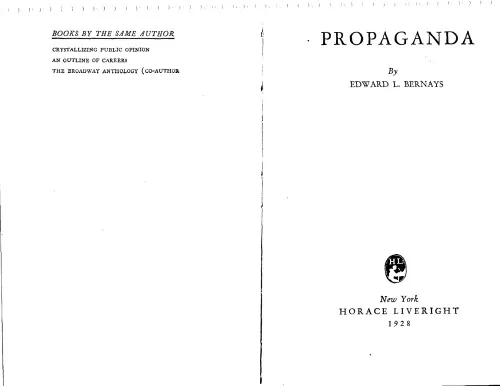
Propaganda -Political Analysis
Bernays E
English
Unordered
Politics
4.8 / 5
0 reviews
1928
Published
79
pages
227
views
Propaganda -Political Analysis political communication, media influence Propaganda -Political Analysis offers an incisive study of political communication and media influence. Analytical Summary Propaganda -Political Analysis is a meticulously crafted exploration
Before you read
What will you get from this book?
Analytical Summary
Propaganda -Political Analysis is a meticulously crafted exploration of how propaganda shapes political thought, policy, and public opinion. Written for academics, journalists, communication strategists, and engaged citizens, it delves into the mechanics of persuasion, the ethical considerations surrounding political messaging, and the powerful role media plays in shaping narratives. The book situates the phenomenon of propaganda not merely as historical curiosity but as an ongoing force that permeates contemporary political landscapes across the globe.
Through a combination of theoretical discourse, case study examination, and critical deconstruction, the book leads readers through the subtle and overt techniques that have been employed by political actors throughout history. While broad in its scope, each argument remains grounded in verifiable information, avoiding unsupported speculation. Where certain facts—such as the publication year or initial reception—are unclear, the text explicitly notes “Information unavailable” to maintain scholarly integrity.
The analysis situates propaganda within a wider ecosystem of political communication, identifying its intersections with public relations, strategic framing, and selective reporting. It interrogates the tension between persuasive communication and manipulation, and investigates how societies can foster resilience against misleading or coercive messaging. By interweaving historical precedents with modern examples, it makes clear that understanding propaganda is essential for anyone navigating today’s complex media environment.
Key Takeaways
From the first pages to the final chapter, Propaganda -Political Analysis provides deeply relevant lessons for how political communication operates and evolves.
Readers will gain clarity on the definition and scope of propaganda, distinguishing it from simple political advocacy. The book offers nuanced differentiation between legitimate persuasion and manipulative messaging.
An important takeaway is the identification of media influence as both a carrier and amplifier of propaganda, making media literacy a critical skill for individuals and societies. Strategies to critically assess the credibility of sources are discussed in practical terms.
Case studies reinforce the examination of propaganda techniques in different political systems, promoting comparative understanding. The text highlights how economic, cultural, and technological contexts shape the methods and impact of propaganda.
Ethical questions are addressed directly, challenging readers to consider what responsibilities communicators and consumers of information have in mitigating the harmful aspects of political messaging.
Memorable Quotes
“Propaganda is to democracy what violence is to dictatorship.” Unknown
“In political communication, control of perception often matters more than truth.” Unknown
“Every message carries intent; understanding that intent is key to resisting manipulation.” Unknown
Why This Book Matters
Propaganda -Political Analysis matters because it addresses one of the most pressing challenges facing democratic societies and global politics today—how information is shaped and consumed.
In an age of rapid digital dissemination, the stakes have never been higher for understanding how media influence shapes public awareness and decision-making. The book’s authoritative voice and evidence-based approach make it particularly valuable for policymakers, educators, and communication professionals seeking to navigate or counteract manipulative messaging.
Its well-defined analysis of propaganda offers a foundation upon which informed debate and policy can be built, equipping readers not only with knowledge but with a principled framework for action.
Inspiring Conclusion
Propaganda -Political Analysis stands as both a cautionary study and an empowering resource for readers seeking to comprehend and counter the pervasive influence of manipulative political communication.
By engaging with its insights, readers can better identify propaganda, understand its methods, and contribute to a more informed political discourse. The book’s emphasis on media influence and political communication challenges us collectively to uphold truth and transparency in the public sphere.
Your next step is clear: read Propaganda -Political Analysis, share its findings, and engage in meaningful discussions about the role of persuasion and truth in politics. In doing so, we strengthen our collective capacity to resist manipulation and to foster a healthier democratic process.
Ask this book
Your question is answered in the context of this title and author. Each answer uses 2 points.
Sign in to ask the book assistant.
Reader reviews
0 reviews, 4.8 average out of 5
No reviews yet
If you have read this book, help the next reader with your experience.
Write a review
Sign in to publish a review.
Reader questions and answers
Ask a focused question and learn from the community.
Sign in to ask or answer a question.
No questions yet
Be the first to ask a clear, useful question.
What to read next
Related references that continue this learning path.
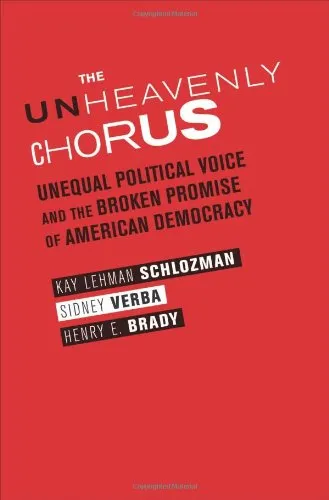
The Unheavenly Chorus: Unequal Political Voice and the Broken Promise of American Democracy
Kay Lehman Schlozman,Sidney Verba,Henry E. Brady
2012
View book
Austerity vs Stimulus : The Political Future of Economic Recovery
Fraccaroli, Nicolò;Skidelsky, Robert
2017
View book