
Book guide and evaluation
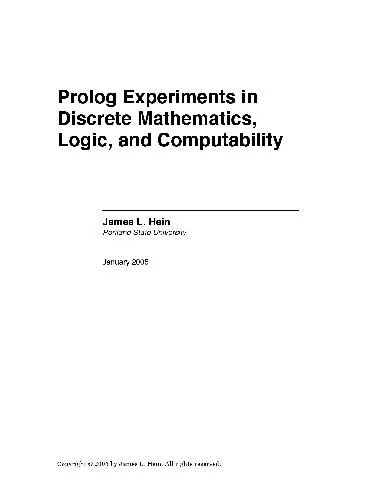
Prolog Experiments in Discrete Mathematics, Logic, and Computability
Hein J. L.
English
Beginner
Technology
4.8 / 5
0 reviews
2005
Published
160
pages
458
views
Detailed Summary of the Book Welcome to the intersection of programming, mathematics, and logic. "Prolog Experiments in Discrete Mathematics, Logic, and Computability" is a comprehensive guide designed for scholars, educators, and enthusiasts keen on exploring these domain
Before you read
What will you get from this book?
Detailed Summary of the Book
Welcome to the intersection of programming, mathematics, and logic. "Prolog Experiments in Discrete Mathematics, Logic, and Computability" is a comprehensive guide designed for scholars, educators, and enthusiasts keen on exploring these domains through the lens of Prolog, a logic programming language.
This book aims to bridge theoretical concepts with practical implementation by using Prolog to experiment with and understand various principles of discrete mathematics, logical reasoning, and computational theory. It takes readers on a journey from the basics of logic programming to more complex applications in these fields, ensuring a hands-on learning experience. Through a series of well-structured experiments and problems, readers develop a deep understanding of the computational dynamics underlying mathematical structures and logical expressions.
The book covers a wide range of topics including sets, relations, functions, logic circuits, automata, grammar, and Turing machines. Each chapter is meticulously crafted to provide both an introduction to theoretical principles and guidance on how to apply these principles in Prolog to solve concrete problems. The use of Prolog makes these abstract concepts accessible and engaging, transforming passive learning into an interactive challenge.
Key Takeaways
- Comprehensive insights into discrete mathematical concepts and their computational applications.
- Hands-on experience in logic programming using Prolog, enhancing problem-solving skills.
- Understanding the link between theoretical logic and practical computation.
- Techniques to implement and interpret computational models such as automata and Turing machines.
- Strengthening analytical skills through real-world problem-solving exercises.
Famous Quotes from the Book
"The beauty of logic lies in its unyielding fidelity to truth, and Prolog is its unerring messenger."
"In the realm of computation, understanding is born from interaction, and Prolog fosters this dialogue with the precision of language."
Why This Book Matters
"Prolog Experiments in Discrete Mathematics, Logic, and Computability" is not just a book; it is a conduit for innovation in teaching and understanding complex topics in mathematics and computer science. It empowers its readers with the ability to relate abstract theoretical ideas to real-world applications, fostering a deeper comprehension that is often elusive in traditional learning avenues.
The book matters because it opens doors to a new way of thinking about and engaging with complex problems. By integrating Prolog, a powerful but often overlooked programming paradigm, with fields that form the foundation of modern computing and mathematics, readers gain an invaluable skill set. This knowledge is crucial not only for educators and students but also for professionals in fields such as computer science, engineering, and data analysis.
Moreover, the book serves as a testament to the importance of computational thinking in modern education. It advocates for a learning environment that encourages experimentation and innovation, skills that are becoming increasingly essential in a world driven by technology and data.
Ask this book
Your question is answered in the context of this title and author. Each answer uses 2 points.
Sign in to ask the book assistant.
Reader reviews
0 reviews, 4.8 average out of 5
No reviews yet
If you have read this book, help the next reader with your experience.
Write a review
Sign in to publish a review.
Reader questions and answers
Ask a focused question and learn from the community.
Sign in to ask or answer a question.
No questions yet
Be the first to ask a clear, useful question.
What to read next
Related references that continue this learning path.
Computation and Logic in the Real World: Third Conference on Computability in Europe, CiE 2007, Siena, Italy, June 18-23, 2007. Proceedings
Luigi Acerbi,Alberto Dennunzio,Enrico Formenti (auth.),S. Barry Cooper,Benedikt Löwe,Andrea Sorbi (eds.)
2007
View book
Proofs and Algorithms: An Introduction to Logic and Computability
Gilles Dowek (auth.)
2011
View book