

Book guide and evaluation
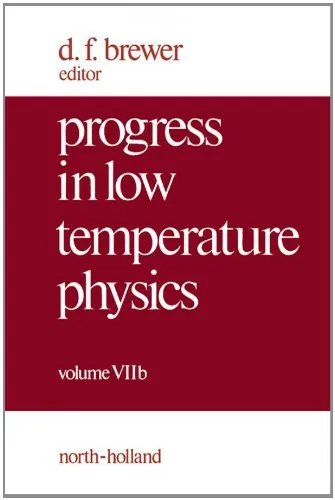
Progress in Low Temperature Physics, , Part B
D.F. Brewer (Ed.)
English
Beginner
Physics
4.7 / 5
0 reviews
1978
Published
411
pages
122
views
Introduction to "Progress in Low Temperature Physics, Vol. 7, Part B" "Progress in Low Temperature Physics, Vol. 7, Part B" is a pivotal and comprehensive work in the field of low-temperature physics, offering deep insights into cutting-edge research and advancements. Edited b
Before you read
What will you get from this book?
Introduction to "Progress in Low Temperature Physics, Vol. 7, Part B"
"Progress in Low Temperature Physics, Vol. 7, Part B" is a pivotal and comprehensive work in the field of low-temperature physics, offering deep insights into cutting-edge research and advancements. Edited by D.F. Brewer, this volume captures the profound developments and intellectual progress in a scientific domain where precision and innovation unveil the extraordinary behaviors of matter under extreme conditions. Like the preceding volumes in the series, this book serves both as a scholarly reference and as foundational material for researchers, educators, and students devoted to exploring the frontier of physical science.
Focusing on the experimental and theoretical advancements at ultra-low temperatures, this volume continues the legacy of presenting the highest caliber of scientific work. Part B of Volume 7 delves deeply into specialized topics, offering an array of meticulously crafted chapters that address the modern challenges and opportunities in low-temperature physics. Beautifully structured and extensively peer-reviewed, it reflects the collaborative spirit of the global scientific community, delivering a compilation of insightful discoveries and technologies that are building blocks for future exploration.
Detailed Summary of the Book
This book highlights significant progress in low-temperature physics, offering insights into the mechanisms, principles, and phenomena encountered at nearly absolute zero. By investigating these extreme states, the book unravels remarkable behaviors such as superfluidity, superconductivity, and quantum mechanical effects in various systems.
The chapters within Part B aim to explore specialized research topics, including quantum fluids, solid-state properties under low temperatures, and novel experimental techniques. The contributors employ both theoretical frameworks and groundbreaking experimental results. This approach ensures that each topic is not only contextually relevant but also forward-looking, bridging the gap between practical applications and fundamental science.
Among the key highlights, the book delves into advancements in understanding fermionic systems, the interaction of quasiparticles, and other quantum phenomena that redefine the limits of classical thermodynamics. Detailed mathematical treatments and experimental methodologies make this book an essential tool for those actively engaged in pushing the boundaries of low-temperature research.
Key Takeaways
- An updated and comprehensive account of quantum fluids and solids at low temperatures.
- Detailed exploration of recent advancements in theoretical frameworks and experimental methods.
- In-depth coverage of superfluidity, superconductivity, and their applications.
- Insights into the interplay of quantum physics and thermodynamics at ultra-low temperatures.
- A resourceful guide for academics, researchers, and industry specialists working on cryogenic applications.
Famous Quotes from the Book
"The beauty of low-temperature physics lies in its ability to reveal the fundamental behaviors of nature when stripped of thermal noise—here, the laws of quantum mechanics reign supreme."
"At the lowest temperatures imaginable, we encounter phenomena that redefine matter as we know it, emphasizing the intricate dance of particles in their quantum states."
Why This Book Matters
The significance of "Progress in Low Temperature Physics, Vol. 7, Part B" cannot be overstated, as it addresses fundamental questions about the universe at its most intricate level. Understanding the properties of matter at ultra-low temperatures extends beyond academic interest; it drives technological innovations in fields like quantum computing, cryogenics, and superconductivity.
The meticulous research presented in this volume serves as a cornerstone for both theoretical and applied sciences, guiding efforts toward achieving revolutionary breakthroughs. From the design of highly sensitive detectors to advances in quantum communication, the work documented in this book paves the way for transformative technologies. Furthermore, it underscores the collaborative nature of the scientific endeavor, drawing upon contributions from leading experts across the world.
Whether for academics delving into quantum mechanics, engineers exploring cryogenic systems, or students aspiring to embark on research careers, this book stands as a touchstone for excellence and innovation. It challenges readers not only to grasp the concepts presented but to imagine the possibilities that can emerge from them, cementing its place as an enduring resource in the field of low-temperature physics.
Ask this book
Your question is answered in the context of this title and author. Each answer uses 2 points.
Sign in to ask the book assistant.
Reader reviews
0 reviews, 4.7 average out of 5
No reviews yet
If you have read this book, help the next reader with your experience.
Write a review
Sign in to publish a review.
Reader questions and answers
Ask a focused question and learn from the community.
Sign in to ask or answer a question.
No questions yet
Be the first to ask a clear, useful question.
What to read next
Related references that continue this learning path.



Modern Computer Vision with PyTorch: A Practical Roadmap From Deep Learning Fundamentals to Advanced Applications and Generative AI, 2nd Edition
V Kishore Ayyadevara,Yeshwanth Reddy
2023
View book