

Book guide and evaluation
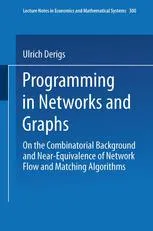
Programming in Networks and Graphs: On the Combinatorial Background and Near-Equivalence of Network Flow and Matching Algorithms
Prof. Dr. Dr. Ulrich Derigs (auth.)
English
Beginner
Economics
5.0 / 5
0 reviews
1988
Published
323
pages
168
views
Introduction to "Programming in Networks and Graphs" "Programming in Networks and Graphs: On the Combinatorial Background and Near-Equivalence of Network Flow and Matching Algorithms" is a profound and scholarly exploration of combinatorial optimization. Authored by Prof.
Before you read
What will you get from this book?
Introduction to "Programming in Networks and Graphs"
"Programming in Networks and Graphs: On the Combinatorial Background and Near-Equivalence of Network Flow and Matching Algorithms" is a profound and scholarly exploration of combinatorial optimization. Authored by Prof. Dr. Dr. Ulrich Derigs, this book delves deeply into the intricate relationship between network flow problems and matching problems, two fundamental areas within operations research and computer science. Designed for academics, researchers, and advanced practitioners, the book is a systematic study of how various algorithmic approaches and mathematical principles interplay to solve diverse problems on networks and graphs.
With a meticulous combination of theory and application, this text takes readers on a journey into the combinatorial structures that underpin network flow and matching algorithms. The work emphasizes their inherent near-equivalence, shining a spotlight on the unified methods that can be applied across both domains. Whether readers are interested in understanding intricate algorithmic principles or applying these insights to practical problems like supply chain optimization, scheduling, or logistics, this book delivers a wealth of knowledge structured for maximum comprehension and utility.
Detailed Summary of the Book
A Comprehensive Exploration of Computational Foundations
The book is structured in a way that first introduces fundamental concepts of graph theory, highlighting the basic elements like vertices, edges, and paths that serve as the foundation for network flow and matching problems. As the narrative progresses, the text moves beyond elementary discussions to explore advanced combinatorial techniques and optimization problems.
A significant portion of the book is dedicated to examining network flow problems. These problems investigate how resources can efficiently move through a network, whether it’s goods in a supply chain, information through a digital network, or even liquids through a pipeline. The Maximum Flow Problem, the Minimum Cost Flow Problem, and their variations are discussed in great detail, with step-by-step insights into classical algorithms such as Ford-Fulkerson, Edmonds-Karp, and others.
The book then transitions to matching problems—a type of combinatorial problem that finds pairings (or matches) within a set, subject to constraints. This section highlights applications ranging from job assignments to stable marriage problems, as well as detailed expositions of pivotal algorithms like the Hungarian Algorithm and the Blossom Algorithm.
What makes this book unique is its focus on the inherent near-equivalence between network flow and matching algorithms. By framing both problem classes in a combinatorial optimization context, the author elaborates on how these domains complement each other despite their apparent differences. The book closes by presenting practical applications and case studies to solidify theoretical knowledge with real-world relevance.
Key Takeaways
- Insightful understanding of graph theory fundamentals and their role in optimization problems.
- Detailed exploration of network flow problems and algorithms, including their variations and extensions.
- Comprehensive treatment of matching algorithms with practical implications in fields like scheduling, logistics, and operations management.
- A scholarly perspective on the near-equivalence of network flow and matching domains, with unified algorithmic approaches.
- A wealth of examples and case studies that bridge theoretical concepts with practical applications.
Famous Quotes from the Book
"The mathematical structures of flow and matching problems are not isolated phenomena but variations on a broader combinatorial theme."
"Understanding the duality and equivalence in combinatorial optimization not only unifies algorithms but also expands their utility across disciplines."
"In the realm of networks and graphs, every solution starts with the elegant simplicity of recognizing a pattern."
Why This Book Matters
A Foundation for Problem-Solving in a Networked World
The modern world is increasingly interconnected, with networks playing a pivotal role in everything from telecommunications to transportation. This book addresses the growing need to approach these complex networks with rigor and clarity, offering readers the tools to solve optimization problems that appear in countless domains. By presenting the theoretical and practical insights of network flow and matching algorithms in a unified framework, the book not only highlights the importance of mathematical structures but also provides actionable methodologies for tackling real-world challenges.
Furthermore, the author's academic rigor ensures that the material is precise yet accessible to dedicated readers. The book occupies a unique space in the literature of combinatorial optimization, bridging the gap between theory and practice while emphasizing the broader implications and applications of these algorithms.
For researchers, students, and professionals eager to deepen their understanding of graph-based problems or enhance their problem-solving toolkit for optimization tasks, "Programming in Networks and Graphs" is an indispensable resource that will remain relevant for years to come.
Ask this book
Your question is answered in the context of this title and author. Each answer uses 2 points.
Sign in to ask the book assistant.
Reader reviews
0 reviews, 5.0 average out of 5
No reviews yet
If you have read this book, help the next reader with your experience.
Write a review
Sign in to publish a review.
Reader questions and answers
Ask a focused question and learn from the community.
Sign in to ask or answer a question.
No questions yet
Be the first to ask a clear, useful question.
What to read next
Related references that continue this learning path.


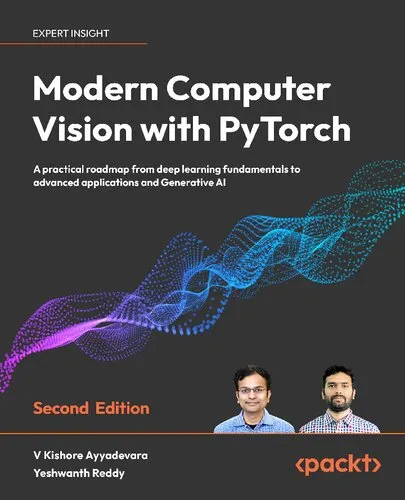
Modern Computer Vision with PyTorch: A Practical Roadmap From Deep Learning Fundamentals to Advanced Applications and Generative AI, 2nd Edition
V Kishore Ayyadevara,Yeshwanth Reddy
2023
View book