
IEEE Trial Use Standard for Application and Management of the Systems Engineering Process (IEEE Std 1220
Software Engineering Standards Committee of the IEEE Computer SociCODE: OS
1994
View book
Book guide and evaluation
Ian T. Cameron,Katalin Hangos
0 reviews
Published
pages
views
Welcome to an exploration of the world of process modeling and model analysis—fields that are foundational to the discipline of process systems engineering. The book Process Modelling and Model Analysis (Process Systems Engineering) serves as an invaluable resource for anyone e
Before you read
Welcome to an exploration of the world of process modeling and model analysis—fields that are foundational to the discipline of process systems engineering. The book Process Modelling and Model Analysis (Process Systems Engineering) serves as an invaluable resource for anyone encountered with the intricacies of process systems, bridging the gap between theoretical models and real-world applications. Our journey here will unveil the inclusive flow of this detailed expertise as captured in this work.
In the complex field of process systems engineering, understanding, designing, and optimizing chemical processes is crucial to advancing technology and efficiency. This book offers a comprehensive swim through a vast ocean of knowledge concerning process modeling and its subsequent analysis. The book begins with fundamental concepts tailored for those initiating their journey into process engineering. It discusses the basic definitions, principles, and scope of process modeling, setting a strong foundation for more complex topics.
Progressing deeper, the book integrates methodologies and tools essential for translating physical and chemical processes into mathematical models. It covers deterministic and stochastic processes, deploying structured approaches to showcase how engineers can solve practical problems in real-time environments. Various modeling techniques such as steady-state, dynamic, lumped, and distributed parameter models are meticulously covered.
Moreover, it emphasizes model analysis, which includes validation and verification techniques, ensuring that the theoretical models apply effectively to real-world scenarios. This book not only offers insights into model development but also instills the ability to critically analyze models for performance optimization.
The pivotal takeaway from this book is the ability to seamlessly convert complex process operations into intuitive models, which can be employed to improve existing systems or create novel solutions. Readers are equipped not only with knowledge of diverse modeling techniques but also with practical skills to implement these models efficiently.
Furthermore, the book offers insights into the criticality of model accuracy, emphasizing model validation and sensitivity analysis to ensure reliability. This fosters an understanding of how to identify and mitigate deviations in real systems. By the book's conclusion, readers are well-prepared to tackle broad challenges across varied process industries.
"The art of modeling is not only to simulate the reality as accurately as possible but to reveal the unseen opportunities hidden within industrial processes."
"A successful engineer must harness both theoretical capacity and practical mindset to transform processes into sustainable engineering achievements."
This book holds significant importance in the realm of process systems engineering for several reasons. Firstly, it serves as a holistic guide that connects theoretical principles with empirical application, making it a critical resource for educators and practitioners alike. Its detailed exposition of methodologies provides a systematic approach to model appreciation and deployment, making the complex task of process optimization accessible.
Secondly, it is invaluable to the advancement of sustainable engineering practices. Readers are encouraged to consider efficiency and sustainability in their designs, reflecting current global trends toward green engineering solutions. These considerations highlight the book's relevance in today's rapidly evolving industry.
Finally, this book is an essential academic companion, guiding students and professionals through the often daunting terrain of industrial system modeling. It empowers them with tools and knowledge to not only address current industrial challenges but foresee and innovate future solutions. In a world consistently seeking increased optimization and reduced environmental impact, this book's content remains crucial.
In conclusion, Process Modelling and Model Analysis (Process Systems Engineering) stands as a testament to the intricate marriage of theory and practice. It invites its readers to not only understand existing processes but to become pioneers in creating efficient, innovative, and sustainable systems for future generations.
Your question is answered in the context of this title and author. Each answer uses 2 points.
0 reviews, 4.0 average out of 5
Sign in to publish a review.
Ask a focused question and learn from the community.
Related references that continue this learning path.
Software Engineering Standards Committee of the IEEE Computer SociCODE: OS
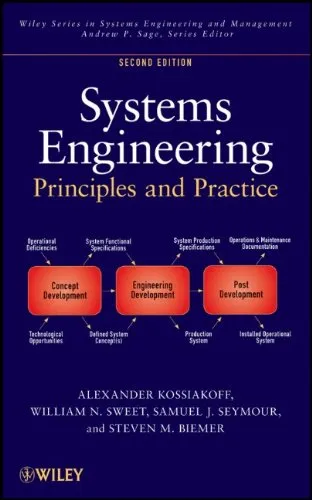
Alexander Kossiakoff,William N. Sweet,Sam Seymour,Steven M. Biemer
Alexander Kossiakoff,William N. Sweet,Sam Seymour,Steven M. Biemer
El-Kabir Boukas