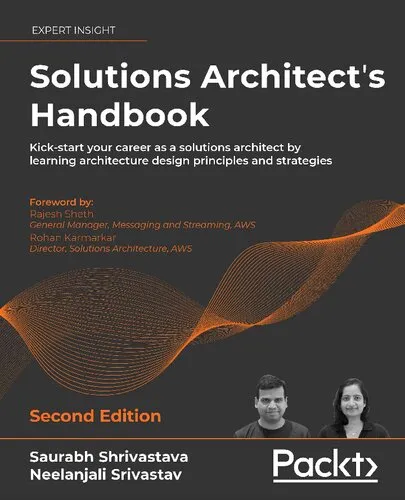
Solutions Architect's Handbook: Kick-start your career as a solutions architect by learning architecture design principles and strategies, 2nd Edition
Saurabh Shrivastava,Neelanjali Srivastav
2022
View book

Book guide and evaluation
Xu, Xiangyang; Ai, Xing; Chen, Renxiang; Jiang, Guosong; Hua, Xia
0 reviews
Published
pages
views
The publication titled "Proceedings of the Institution of Mechanical Engineers Part D: Journal of Automobile Engineering, pp. 2364—2376" by Xu, Xiangyang; Ai, Xing; Chen, Renxiang; Jiang, Guosong; and Hua, Xia represents a significant scholarly contribution to the fie
Before you read
The publication titled "Proceedings of the Institution of Mechanical Engineers Part D: Journal of Automobile Engineering, pp. 2364—2376" by Xu, Xiangyang; Ai, Xing; Chen, Renxiang; Jiang, Guosong; and Hua, Xia represents a significant scholarly contribution to the field of automotive engineering. This work delves into advanced methodologies, experimental analysis, and computational approaches aimed at improving vehicle performance, safety, and sustainability. While it is part of a broader peer-reviewed journal series, this particular segment addresses niche yet crucial aspects of modern automobile engineering, blending theoretical insights with practical case studies for researchers, engineers, and industry practitioners.
This paper presents state-of-the-art research on a highly specialized topic in automotive engineering, incorporated within the respected Proceedings of the Institution of Mechanical Engineers Part D. The authors focus on bridging the gap between theory and practice in developing innovative vehicle systems. The discussion includes the design and optimization of critical automotive components, application of computational modeling techniques, and integration of safety protocols within contemporary vehicle frameworks.
The publication meticulously presents literature reviews, experimental setups, and data analysis to substantiate findings. It explores energy efficiency strategies, load distribution optimization, and component fatigue life in high-stress automotive environments. The authors detail their use of advanced simulation models to predict performance outcomes, backed by real-world trial data. The integration of environmental impact assessments within mechanical optimization discussions highlights a holistic approach to engineering practice.
The work further emphasizes collaboration between academia and industry, showcasing how multi-disciplinary research can lead to tangible advancements in automotive technology. This makes the publication not only a technical reference but also a roadmap for addressing future industry challenges such as electrification, autonomous driving, and reduction of lifecycle carbon emissions.
As a technical and academic work rather than a narrative book, the quotes from this publication are drawn from key conceptual statements that encapsulate its technical philosophy and research mission:
"Engineering innovation must not only advance vehicle performance but also honor commitments to environmental stewardship."
"Rigorous computational prediction paired with empirical validation results in engineering designs that stand the test of real-world conditions."
"Automotive engineering is at its most transformative when traditional mechanics meet modern sustainability demands."
In an era where automotive technologies are evolving at an unprecedented pace, publications like this serve as essential guiding resources for both academic researchers and industry engineers. The findings and methodologies discussed provide actionable insights into the optimization of vehicle design and safety protocols. Furthermore, its emphasis on sustainability aligns with global environmental goals, making it highly relevant in today’s context.
By leveraging thorough experimental analysis combined with computational innovation, the authors highlight pathways toward safer, more efficient, and eco-conscious vehicles. This is crucial for industries facing pressures from regulators, markets, and consumers to deliver products that not only perform exceptionally but also meet rigorous environmental standards.
With the rise of connected and autonomous vehicles, the systematic approach presented in this work positions it as a cornerstone reference that will continue to influence automotive engineering for years to come. Its depth of technical detail, combined with practical applicability, ensures that it remains a valued contribution to scholarly literature and industry practice alike.
Your question is answered in the context of this title and author. Each answer uses 2 points.
0 reviews, 4.5 average out of 5
Sign in to publish a review.
Ask a focused question and learn from the community.
Related references that continue this learning path.
Saurabh Shrivastava,Neelanjali Srivastav

Thomas A. Limoncelli,Strata R. Chalup,Christina J. Hogan