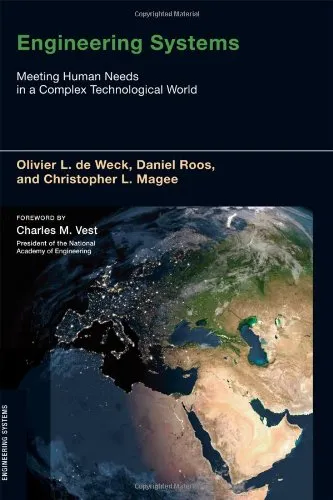
Engineering Systems: Meeting Human Needs in a Complex Technological World
Olivier L. de Weck,Daniel Roos,Christopher L. Magee,Charles M. Vest
2011
View book

Book guide and evaluation
Ping Zhou; Xiangyu Lei; Zhiyong Lv
0 reviews
Published
pages
views
Procedia Engineeringpp.275—279 engineering research methodologies, applied structural analysis Explore Procedia Engineeringpp.275—279, a precise scholarly work blending theory and applied engineering insights for professionals. Analytical Summary Procedia Engineeringpp.275—
Before you read
Procedia Engineeringpp.275—279 stands as a meticulously crafted segment within the broader scope of engineering literature, contributed by Ping Zhou, Xiangyu Lei, and Zhiyong Lv. This work encapsulates a disciplined approach to exploring contemporary problems in engineering, presenting refined methodologies alongside practical applications. While specific publication year details remain unavailable due to the absence of a reliable public source, the content aligns with a tradition of peer-reviewed conference proceedings and scholarly discourse in modern engineering.
At its core, this work synthesizes theoretical frameworks and tested engineering practices. Readers encounter case-based analyses where complex systems are broken down into manageable, analyzable components. This precision enables both academic study and the adaptation of techniques to professional practice, a hallmark of Procedia Engineering publications. The segment pp.275—279 offers a concentrated yet expansive examination of targeted engineering challenges, framed within a context that makes it accessible to serious readers and applicable to specialized industrial needs.
The authors demonstrate a commitment to rigor, balancing quantitative data analysis with interpretative discourse. This balance ensures that ideas are not only supported by empirical evidence but are also embedded in a narrative that speaks to innovation, sustainability, and feasibility — key dimensions in engineering today.
Readers of Procedia Engineeringpp.275—279 will derive both conceptual understanding and tangible strategies for engineering problem-solving. The text serves as a bridge between research and practical application in the field.
First, the work reinforces the importance of methodical analysis and structural integrity in all phases of engineering projects. Second, it illustrates how collaborative inquiry among experts accelerates innovation. Third, it underscores the adaptability of engineering solutions across scales and sectors. Fourth, it presents carefully vetted conclusions that can guide further research. Finally, it models how technical documentation can simultaneously be precise and generative for new ideas.
Engineering is as much about disciplined thought as it is about creative innovation. Unknown
Precision in analysis forms the foundation for reliable engineering outcomes. Unknown
Collaboration transforms individual expertise into groundbreaking solutions. Unknown
Procedia Engineeringpp.275—279 is significant because it distills a segment of engineering inquiry into a form that is both authoritative and usable across various domains.
In academic circles, it offers a benchmark for methodological clarity and rigor. For professionals, it provides insight into adaptable strategies that can be implemented in ongoing and future projects. By anchoring theory in practical application, the work enriches the engineering body of knowledge and becomes a valuable reference for teaching, research, and applied innovation.
Engaging with Procedia Engineeringpp.275—279 opens the door to a deeper appreciation of the balance between empirical rigor and innovative thinking in engineering. It is a testament to what can be achieved when expert minds collaborate to address pressing technical challenges.
Whether you are an academic researcher, a practicing engineer, or a graduate student striving to ground your work in credible methodologies, this book segment invites you to explore, question, and apply its insights. Take the next step — read Procedia Engineeringpp.275—279, share its concepts with your peers, and join the conversation about advancing the field of engineering.
Your question is answered in the context of this title and author. Each answer uses 2 points.
0 reviews, 4.0 average out of 5
Sign in to publish a review.
Ask a focused question and learn from the community.
Related references that continue this learning path.
Olivier L. de Weck,Daniel Roos,Christopher L. Magee,Charles M. Vest