

Book guide and evaluation
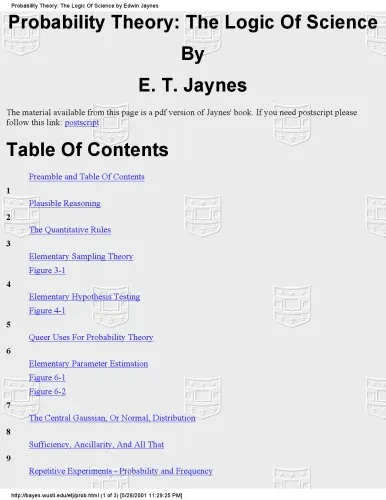
Probability Theory: The Logic of Science
Edwin T. Jaynes
English
Beginner
Art
4.7 / 5
0 reviews
1995
Published
592
pages
219
views
Introduction to 'Probability Theory: The Logic of Science' Written by Edwin T. Jaynes, Probability Theory: The Logic of Science is a thoroughly transformative exploration of probability theory, examining its foundations, applications, and philosophical implications. Jaynes mas
Before you read
What will you get from this book?
Introduction to 'Probability Theory: The Logic of Science'
Written by Edwin T. Jaynes, Probability Theory: The Logic of Science is a thoroughly transformative exploration of probability theory, examining its foundations, applications, and philosophical implications. Jaynes masterfully bridges mathematical rigor with intuitive understanding, offering readers more than just a dry textbook—it is a revolutionary perspective on the very nature of scientific reasoning.
Detailed Summary of the Book
The book delves into the principles of Bayesian probability, presenting probability as an extension of logic itself. Jaynes aims to reveal the role of probability theory not merely as a mathematical tool but as the universal language of scientific inference. This thematic approach tackles common misunderstandings and objections to Bayesian methods, establishing a robust logical framework for evaluating uncertainty.
Starting with the essentials, Jaynes develops the subject from the ground up. He begins with the motivation for probability theory as an extension of Aristotelian logic and progresses to address classical paradoxes, such as Bertrand's paradox, within the Bayesian framework. The book also discusses major concepts like the maximum entropy principle, hypothesis testing, parameter estimation, and the underlying principles of inductive reasoning.
The text stands out for its application of probability theory across diverse fields. Whether it's analyzing physical systems, statistical mechanics, economic decision-making, or communication theory, Jaynes demonstrates the universal relevance of these concepts. Along the way, practical examples and thought experiments illuminate the content, ensuring accessibility for a range of readers.
With a foundation rooted in rigorous mathematics and philosophical clarity, this book is an invaluable resource for scientists, statisticians, engineers, and anyone interested in the logical underpinnings of scientific discovery.
Key Takeaways
- Probability as Extended Logic: Jaynes argues that probability theory is not merely a statistical tool but a continuation of deductive reasoning, essential for making rational decisions.
- Bayesian Perspective: The book solidifies Bayesian inference as the most consistent and rational approach to uncertainty, illuminating how prior information and likelihoods are synthesized into posterior probabilities.
- Maximum Entropy Principle: Jaynes introduces the principle of maximum entropy as a critical method for objective reasoning when limited information is available.
- Applications Across Disciplines: The book moves beyond theory to show how probability theory provides solutions across physics, engineering, and even economics.
- Unified Thinking: By presenting a coherent view of probability theory as logic, Jaynes encourages readers to think critically, rigorously, and systematically about uncertainty and evidence.
Famous Quotes from the Book
"The purpose of probability theory is not to deal with uncertainty for its own sake, but to get at the truth behind the uncertainty."
"Our problem is to translate the principles of human reasoning into exact mathematical form."
"The art of probability consists in conveying information about plausible reasoning to those whose ideas are clouded by misunderstanding."
Why This Book Matters
Probability Theory: The Logic of Science stands as a cornerstone in the study of Bayesian probability and scientific inference. Its significance lies not just in the topics it covers but in its profound implications for the way we think and reason. Jaynes challenges us to reconsider the foundations of logic, science, and statistical thinking, providing readers with a robust framework for confronting real-world problems with clarity and precision.
The book has inspired a generation of scientists, statisticians, and philosophers, emphasizing that probability theory is more than a collection of rules—it is, as the title suggests, the logic of science. As challenges in data analysis, decision-making, and uncertainty continue to grow in complexity, Jaynes' insights remain more timely and relevant than ever.
With its blend of deep theoretical exploration, practical examples, and a uniquely philosophical perspective, this book offers a transformative experience for anyone interested in the logical foundations of science and knowledge.
Ask this book
Your question is answered in the context of this title and author. Each answer uses 2 points.
Sign in to ask the book assistant.
Reader reviews
0 reviews, 4.7 average out of 5
No reviews yet
If you have read this book, help the next reader with your experience.
Write a review
Sign in to publish a review.
Reader questions and answers
Ask a focused question and learn from the community.
Sign in to ask or answer a question.
No questions yet
Be the first to ask a clear, useful question.
What to read next
Related references that continue this learning path.


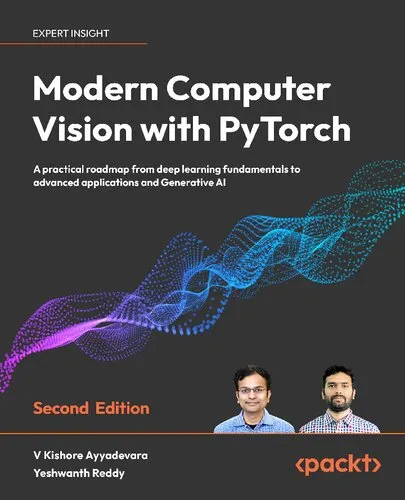
Modern Computer Vision with PyTorch: A Practical Roadmap From Deep Learning Fundamentals to Advanced Applications and Generative AI, 2nd Edition
V Kishore Ayyadevara,Yeshwanth Reddy
2023
View book