

Spherical Crystallization as a New Platform for Particle Design Engineering
Yoshiaki Kawashima
2019
View book
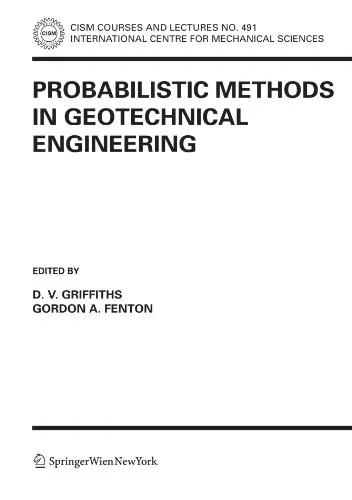
Book guide and evaluation
D. V. Griffiths,G. A. Fenton
0 reviews
Published
pages
views
Welcome to the introduction of Probabilistic Methods in Geotechnical Engineering, a groundbreaking work authored by D.V. Griffiths and G.A. Fenton, published by the CISM International Centre for Mechanical Sciences. This comprehensive book serves as a critical resource for en
Before you read
Welcome to the introduction of Probabilistic Methods in Geotechnical Engineering, a groundbreaking work authored by D.V. Griffiths and G.A. Fenton, published by the CISM International Centre for Mechanical Sciences. This comprehensive book serves as a critical resource for engineers, researchers, and academics seeking to understand and implement probabilistic models in the field of geotechnical engineering.
The book delves into probabilistic and stochastic approaches in geotechnical engineering, which provide a departure from traditional deterministic methods. While conventional geotechnical engineering often relies on fixed parameters and assumptions, this book focuses on incorporating uncertainty into designs and decision-making processes. The authors aim to bridge the gap between theory and practice, offering readers insights into concepts like variability, random fields, risk assessment, and Monte Carlo simulations.
Each chapter is meticulously crafted to explore topics ranging from fundamental probability concepts to advanced modeling techniques. The text is rich with numerical examples, case studies, and exhaustive explanations of methods, allowing readers to see the practical applications of probabilistic techniques in real-world scenarios. By integrating statistical analyses into the study of soil mechanics and foundation design, the book equips professionals to address uncertainty and variability in geotechnical properties, such as cohesion, friction angle, and permeability.
Written in an accessible style, the book is suitable both as a textbook for upper-level undergraduate and graduate courses, as well as a reference guide for practitioners in the field. Its interdisciplinary perspective merges civil engineering concepts with applied mathematics and statistics, making it an invaluable resource across disciplines.
"The role of uncertainty is not to be feared but instead embraced as an integral aspect of engineering analysis."
"By incorporating probabilistic methods, engineers can better address spatial variability and improve decision-making under uncertainty."
"The transition from deterministic to probabilistic thinking in geotechnical engineering is not a luxury; it is a necessity."
The relevance of Probabilistic Methods in Geotechnical Engineering lies in its ability to address challenges of uncertainty, variability, and risk—factors that are omnipresent in the natural conditions underlying engineering projects. As practitioners face increasing demands for safety, performance reliability, and cost efficiency, the use of probabilistic methods becomes indispensable.
Geotechnical failures can have severe consequences both monetarily and socially, making risk assessment paramount in the design process. This book equips engineers to move beyond deterministic assumptions, offering tools to forecast uncertainties, evaluate risks comprehensively, and make informed decisions that account for variability. By fostering such competencies, the book contributes to safer and more efficient engineering practices.
Moreover, the interdisciplinary nature of the book makes it a significant addition to the engineering canon. Its application extends beyond geotechnical projects, offering robust methodologies pertinent to a wide array of disciplines. Students, educators, and professionals alike will find its content inspiring and transformative, ensuring its continued relevance in a constantly evolving industry.
Your question is answered in the context of this title and author. Each answer uses 2 points.
0 reviews, 4.5 average out of 5
Sign in to publish a review.
Ask a focused question and learn from the community.
Related references that continue this learning path.
Yoshiaki Kawashima
Dr. Cherry Bhargava,Dr. Pardeep Kumar Sharma

Preeti Malik, Lata Nautiyal, Mangey Ram