
Book guide and evaluation
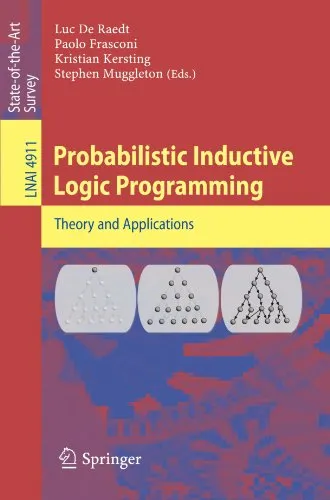
Probabilistic Inductive Logic Programming: Theory and Applications
Luc De Raedt,Kristian Kersting (auth.),Luc De Raedt,Paolo Frasconi,Kristian Kersting,Stephen Muggleton (eds.)
English
Advanced
Artificial Intelligence (AI)
4.4 / 5
0 reviews
2008
Published
347
pages
378
views
The question, how to combine probability and logic with learning, is getting an increased attention in several disciplines such as knowledge representation, reasoning about uncertainty, data mining, and machine learning simulateously. This results in the newly emerging subfield k
Before you read
What will you get from this book?
The question, how to combine probability and logic with learning, is getting an increased attention in several disciplines such as knowledge representation, reasoning about uncertainty, data mining, and machine learning simulateously. This results in the newly emerging subfield known under the names of statistical relational learning and probabilistic inductive logic programming.This book provides an introduction to the field with an emphasis on the methods based on logic programming principles. It is concerned with formalisms and systems, implementations and applications, as well as with the theory of probabilistic inductive logic programming.The 13 chapters of this state-of-the-art survey start with an introduction to probabilistic inductive logic programming; moreover the book presents a detailed overview of the most important probabilistic logic learning formalisms and systems such as relational sequence learning techniques, using kernels with logical representations, Markov logic, the PRISM system, CLP(BN), Bayesian logic programs, and the independent choice logic. The third part provides a detailed account of some show-case applications of probabilistic inductive logic programming. The final part touches upon some theoretical investigations and includes chapters on behavioural comparison of probabilistic logic programming representations and a model-theoretic expressivity analysis.
Ask this book
Your question is answered in the context of this title and author. Each answer uses 2 points.
Sign in to ask the book assistant.
Reader reviews
0 reviews, 4.4 average out of 5
No reviews yet
If you have read this book, help the next reader with your experience.
Write a review
Sign in to publish a review.
Reader questions and answers
Ask a focused question and learn from the community.
Sign in to ask or answer a question.
No questions yet
Be the first to ask a clear, useful question.
What to read next
Related references that continue this learning path.
The Definitive Guide to Google Vertex AI: Accelerate your machine learning journey with Google Cloud Vertex AI and MLOps
Jasmeet Bhatia | Kartik Chaudhary
2023
View book