

Site Reliability Engineering: How Google Runs Production Systems
Betsy Beyer,Chris Jones,Jennifer Petoff,Niall Richard Murphy
2016
View book
Book guide and evaluation
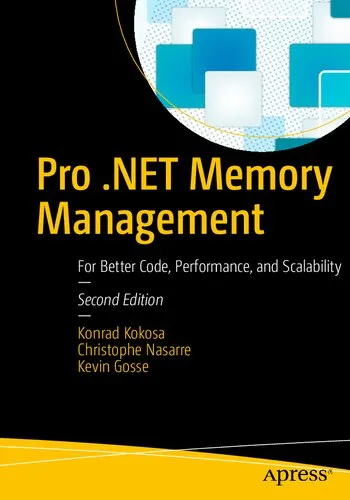
Konrad Kokosa;Christophe Nasarre;Kevin Gosse
0 reviews
Published
pages
views
Welcome to the introduction of Pro .NET Memory Management: For Better Code, Performance, and Scalability. This comprehensive guide dives deep into the intricacies of memory management in .NET to help developers produce optimized, high-performing, and scalable applications. Writ
Before you read
Welcome to the introduction of Pro .NET Memory Management: For Better Code, Performance, and Scalability. This comprehensive guide dives deep into the intricacies of memory management in .NET to help developers produce optimized, high-performing, and scalable applications. Written by experienced experts, this book aims to demystify the art and science of .NET memory management. Whether you're a seasoned developer or just stepping into the .NET ecosystem, this book will enhance your technical proficiency and elevate your coding practices.
The book Pro .NET Memory Management serves as a definitive resource for understanding how memory is allocated, utilized, and reclaimed in .NET applications. Memory management is a cornerstone of programming efficiency, but its complexity often intimidates developers. This book addresses this challenge head-on by breaking down complicated concepts into manageable, actionable insights.
It covers a wide array of topics, beginning with foundational concepts of the Common Language Runtime (CLR), heaps versus stacks, and the role of garbage collection. As the chapters progress, readers are introduced to techniques for analyzing memory usage, optimizing the allocation of resources, and avoiding memory leaks that lead to performance issues. Advanced topics like generational garbage collection, finalization, weak references, and interop with unmanaged code are elucidated with practical examples and detailed explanations to ensure a holistic understanding.
What sets this book apart is its wealth of actionable strategies and real-world case studies tailored specifically for .NET developers. The accompanying code samples bring theoretical concepts to life, and performance benchmarks allow readers to quantify improvements in their applications. Concepts such as memory profiling, benchmarking, and diagnosing performance bottlenecks are explained in depth, making this book an essential resource for developers who care about efficient resource utilization.
Ultimately, this book offers a roadmap to achieving robust application performance and scalability by mastering memory management principles.
"Memory management is not just an optimization strategy; it's an essential skill for building responsive and scalable .NET applications."
"Understanding how garbage collection works is akin to learning the pulse of your application. Ignore it at your own peril."
"Writing high-quality code is more than just achieving functionality; it's about ensuring the code performs well even under stress."
In today's era of software development, where performance and scalability are more critical than ever, mastering memory management has become an indispensable skill. Poor memory management can lead to application crashes, degraded performance, and wasted resources—issues that can tarnish user experience, increase operational costs, and harm organizational reputation.
This book empowers developers to proactively manage these challenges by fostering a deep understanding of memory-related mechanisms in .NET. With platforms like .NET Core and .NET Framework evolving rapidly, this resource remains relevant, helping developers build resilient cloud-enabled and microservices-based applications.
Moreover, the actionable insights and practical tutorials provided in this book bridge the gap between abstract theory and real-world application. By implementing the provided guidelines, developers can achieve faster performance, reduce resource consumption, and positively impact their organization's bottom line.
For anyone aiming to craft high-performing software while mastering one of the most underrated aspects of programming, Pro .NET Memory Management is not just a book—it's a must-have tool.
Your question is answered in the context of this title and author. Each answer uses 2 points.
0 reviews, 4.7 average out of 5
Sign in to publish a review.
Ask a focused question and learn from the community.
Related references that continue this learning path.
Betsy Beyer,Chris Jones,Jennifer Petoff,Niall Richard Murphy


Mario Casciaro,Luciano Mammino