
Book guide and evaluation
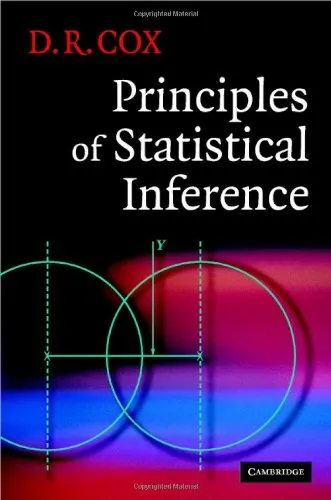
Principles of statistical inference
D. R. Cox
English
Beginner
Mathematics
4.4 / 5
0 reviews
2006
Published
236
pages
244
views
Introduction to 'Principles of Statistical Inference' Written by the distinguished statistician D. R. Cox, Principles of Statistical Inference provides a comprehensive exploration into the philosophical foundations and practical methodologies of statistical inferen
Before you read
What will you get from this book?
Introduction to 'Principles of Statistical Inference'
Written by the distinguished statistician D. R. Cox, Principles of Statistical Inference provides a comprehensive exploration into the philosophical foundations and practical methodologies of statistical inference. This book offers a blend of theoretical depth and practical insights, making it invaluable to students, researchers, and professionals seeking to deepen their understanding of the subject. Engaging with questions about how we form conclusions from data and discussing the frameworks that guide statistical methods, this work stands as a seminal contribution to the field of statistics.
As statistical analysis continues to play a pivotal role in disciplines ranging from data science to medical studies and social sciences, an understanding of statistical inference has become indispensable. D. R. Cox presents his views on contentious topics within the discipline, exploring both classical and modern approaches to inference. By focusing on the principles that underlie statistical decision-making, this book bridges the gap between mathematical rigor and real-world application, ultimately equipping readers with the ability to think critically about statistical practice.
A Detailed Summary of the Book
Spanning a wide range of topics, Principles of Statistical Inference begins with an introduction to the overarching goals of statistical inference. It sets the stage by addressing the fundamental question: how do we draw conclusions from observed data while accounting for uncertainty? D. R. Cox emphasizes the role of probability as a means of quantifying uncertainty and discusses how different frameworks of inference—such as frequentist, Bayesian, and likelihood-based approaches—handle this uncertainty in diverse ways.
The book delves deeply into the interplay between theory and application. It outlines crucial concepts such as likelihood, sufficiency, and conditioning, explaining their significance in sound statistical reasoning. Key topics include hypothesis testing, estimation, model selection, and the challenges associated with interpreting p-values. D. R. Cox meticulously evaluates both the strengths and limitations of various methods, drawing attention to their implications in practical scenarios.
Another essential aspect of this book is its emphasis on the philosophical foundations of statistical thought. Through discussions on issues like prior information, asymptotics, and robustness, readers gain an appreciation for the complexity of inference and the assumptions underlying statistical models. The text culminates in reflections on current trends in statistical research and future directions for the field, encouraging readers to adopt a thoughtful and reflective approach as practitioners of statistics.
Key Takeaways
- Understanding the differences between frequentist, Bayesian, and likelihood-based approaches to inference.
- The importance of concepts like likelihood, sufficiency, and conditioning in statistical reasoning.
- Recognizing the limitations of statistical methods and the nuances of interpreting results in real-world problems.
- The role of prior assumptions and philosophical considerations in shaping statistical conclusions.
- Presenting statistical inference as both a theoretical discipline and a practical tool for decision-making.
Famous Quotes from the Book
"Statistical methods are not just techniques for analyzing data but an approach to understanding and reasoning under conditions of uncertainty."
"In statistical inference, it is often as important to understand the assumptions and approximations being made as it is to understand the technical details of the methodology."
"The aim is not merely numerical precision but rather clarity and relevance in interpreting the conclusions."
Why This Book Matters
Principles of Statistical Inference is not merely a textbook; it is a thought-provoking exploration of the principles that guide statistical thought and practice. Unlike many technical works, it engages deeply with the philosophical questions underpinning the discipline, making it unique in its approach. For students, it serves as an accessible yet rigorous introduction to the complexities of inference. For seasoned practitioners, it provides a reflective lens through which to evaluate their own methodologies and assumptions.
In an era where data-driven decision-making drives innovation and policy, understanding statistical inference has never been more critical. D. R. Cox's book reminds readers that statistical methods are only as robust as the assumptions and principles behind them. By fostering critical thinking and clarity of concepts, this book equips its readers to make informed decisions, avoid common pitfalls, and navigate the challenges of modern data analysis confidently.
Ask this book
Your question is answered in the context of this title and author. Each answer uses 2 points.
Sign in to ask the book assistant.
Reader reviews
0 reviews, 4.4 average out of 5
No reviews yet
If you have read this book, help the next reader with your experience.
Write a review
Sign in to publish a review.
Reader questions and answers
Ask a focused question and learn from the community.
Sign in to ask or answer a question.
No questions yet
Be the first to ask a clear, useful question.
What to read next
Related references that continue this learning path.


Modern Computer Vision with PyTorch: A Practical Roadmap From Deep Learning Fundamentals to Advanced Applications and Generative AI, 2nd Edition
V Kishore Ayyadevara,Yeshwanth Reddy
2023
View book