
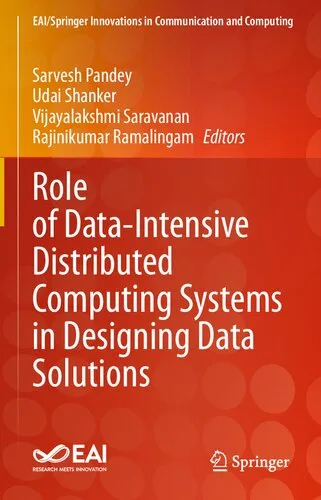
Role of Data-Intensive Distributed Computing Systems in Designing Data Solutions
Sarvesh Pandey,Udai Shanker,Vijayalakshmi Saravanan,Rajinikumar Ramalingam
2023
View book

Book guide and evaluation
Butler Lampson (auth.),Mariam Momenzadeh Alexander A. Shvartsman (eds.)
0 reviews
Published
pages
views
Introduction to the Book "Principles of Distributed Systems: 10th International Conference, OPODIS 2006, Bordeaux, France, December 12-15, 2006. Proceedings" is a comprehensive collection of research presented during the 10th edition of the OPODIS conference. It explores k
Before you read
"Principles of Distributed Systems: 10th International Conference, OPODIS 2006, Bordeaux, France, December 12-15, 2006. Proceedings" is a comprehensive collection of research presented during the 10th edition of the OPODIS conference. It explores key concepts, problems, and solutions in the domain of distributed systems—an essential area of computer science concerning systems that span across multiple interconnected computers. This book brings together a wealth of innovative ideas and breakthrough findings that drive the field of distributed systems forward, offering insight into both theory and practice.
The OPODIS conference series provides a distinguished platform for international researchers, practitioners, and academics to exchange ideas and unveil new findings in distributed systems and related domains. This book serves as the official proceedings of the 2006 conference, containing peer-reviewed papers that represent cutting-edge advancements. Topics range from network algorithms, fault tolerance, security, and synchronization to emerging trends like peer-to-peer systems and mobile computing. The content of this book is relevant for graduate students, researchers, system designers, and IT professionals looking to deepen their knowledge of distributed systems.
This book delves into innovative solutions and methodologies essential for the design and implementation of distributed systems. Compiling the prestigious research presented at OPODIS 2006, the proceedings tackle a range of challenges that arise when designing and analyzing distributed environments. By focusing on diverse aspects of distributed systems—algorithms, scalability, fault tolerance, and security—this book offers a multifaceted understanding of the field.
The papers span theoretical foundations and applied technologies, making it a unique resource. Specific topics include the effectiveness of distributed algorithms, the intricacies of consensus protocols, clock synchronization mechanisms, and secure communication in distributed settings. With rapid advancements in technology, exploring mobile and peer-to-peer systems is also a highlight. Readers can expect a meticulous treatment of efficiency, reliability, and robustness—qualities that are central to distributed computing.
The proceedings contain thought-provoking and impactful statements from leading researchers that encapsulate the importance and challenges of distributed systems. Below are a few memorable quotes:
"In distributed systems, achieving agreement across unreliable nodes is not merely a problem—it's a paradox we choose to solve."
"Fault tolerance isn't just about redundancy; it's about anticipating failure as an inevitable part of any complex system."
As distributed systems continue to underpin modern digital infrastructure, their complexity and significance escalate correspondingly. From powering cloud computing to enabling large-scale data processing and real-time collaboration tools, distributed systems are the backbone of technological progress. This book is a vital resource for those aiming to understand and innovate within this dynamic field.
With groundbreaking research from esteemed contributors, the OPODIS 2006 proceedings foster an environment of academic excellence and practical problem-solving. Whether you are a student seeking foundational knowledge, a researcher pursuing new insights, or an industry professional tackling practical distributed computing challenges, this book equips you with the tools and knowledge needed to succeed. Furthermore, as it features a wide range of topics, this book highlights the interdisciplinary nature of distributed systems, connecting theory, application, and future directions.
Ultimately, this book serves to not just inform but also inspire readers to contribute to the field of distributed computing, making it a cornerstone reference for the community.
Your question is answered in the context of this title and author. Each answer uses 2 points.
0 reviews, 4.0 average out of 5
Sign in to publish a review.
Ask a focused question and learn from the community.
Related references that continue this learning path.
Sarvesh Pandey,Udai Shanker,Vijayalakshmi Saravanan,Rajinikumar Ramalingam
Richard Anthony

Rance Cleaveland (auth.),Jos C. M. Baeten,Sjouke Mauw (eds.)

Laurent Baduel,Satoshi Matsuoka (auth.),Eduardo Tovar,Philippas Tsigas,Hacène Fouchal (eds.)