
Book guide and evaluation
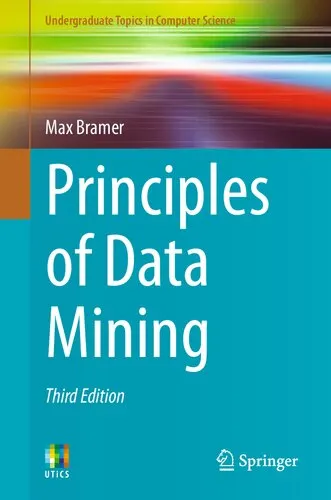
Principles of Data Mining (Undergraduate Topics in Computer Science)
Max Bramer
English
Beginner
Software Engineering
4.5 / 5
0 reviews
2016
Published
530
pages
408
views
Introduction to "Principles of Data Mining" Welcome to the world of Data Mining—a fascinating and powerful field that seamlessly blends mathematics, computer science, and domain expertise to uncover insights from vast amounts of data. "Principles of Data Mining," part of the
Before you read
What will you get from this book?
Introduction to "Principles of Data Mining"
Welcome to the world of Data Mining—a fascinating and powerful field that seamlessly blends mathematics, computer science, and domain expertise to uncover insights from vast amounts of data. "Principles of Data Mining," part of the Undergraduate Topics in Computer Science series, is designed as a concise yet comprehensive guide to the essential principles, techniques, and algorithms that form the backbone of data mining. Whether you're a student delving into the field for the first time, an educator looking for a balanced introduction, or a practitioner eager to strengthen your theoretical foundation, this book provides an invaluable resource for all levels of expertise.
Detailed Summary of the Book
Divided into carefully organized chapters, "Principles of Data Mining" balances theory with practical applications. It starts with an accessible introduction to the key concepts, so no prior knowledge of data mining or specialized mathematics is required. The book gradually explores advanced topics, including classification algorithms, cluster analysis, association rule mining, and data preprocessing techniques.
The text emphasizes a clear understanding of the logic and purpose behind each algorithm, demystifying topics with worked examples and intuitive explanations. For students and professionals alike, this approach encourages hands-on problem-solving and strengthens foundational knowledge before diving into coding or real-world applications. Topics such as decision trees, k-means clustering, and rule induction are discussed in depth, alongside practical aspects like dealing with missing data and performance evaluation.
The inclusion of exercises at the end of each chapter allows readers to test their understanding and reinforce their learning. Mathematical sections are framed in an approachable format, ensuring precision without intimidating those with limited prior exposure to advanced mathematics.
Key Takeaways
- A robust foundation in classic data mining techniques.
- In-depth coverage of popular algorithms like decision trees, k-means clustering, and association rule mining.
- Simplified explanations of complex mathematical concepts.
- Practical strategies for data preprocessing and cleaning.
- Opportunities to apply theoretical concepts through exercises and real-world case studies.
Famous Quotes from the Book
"Data mining is not about simply collecting data. It is about transforming that data into meaningful patterns, inferences, and actionable knowledge."
"Every algorithm, no matter how complex, starts with a simple and logical idea. Understanding that idea is the first step toward mastering it."
"The power of data lies not in its quantity but in its relevance and the ability to extract actionable insights."
Why This Book Matters
In the era of Big Data, the ability to extract valuable insights from large datasets has become a critical skill across many industries. "Principles of Data Mining" equips students and professionals with the knowledge required to tackle the challenges of data analysis methodically and effectively. By emphasizing not only the 'how' but also the 'why' behind data mining techniques, the book fosters deeper understanding and prepares readers to adapt and innovate as the field continues to evolve.
Unlike many texts that focus solely on coding or advanced mathematics, this book bridges the gap between theory and practical application. It empowers readers to comprehend the rationale behind algorithms, evaluate their suitability for different problems, and ensure their implementation achieves meaningful results.
Whether applied to fields as diverse as healthcare, finance, marketing, or social sciences, the principles explored in this book have real-world significance. By mastering these principles, readers position themselves at the forefront of a discipline that is driving groundbreaking advances in decision-making, automation, and predictive modeling.
Ask this book
Your question is answered in the context of this title and author. Each answer uses 2 points.
Sign in to ask the book assistant.
Reader reviews
0 reviews, 4.5 average out of 5
No reviews yet
If you have read this book, help the next reader with your experience.
Write a review
Sign in to publish a review.
Reader questions and answers
Ask a focused question and learn from the community.
Sign in to ask or answer a question.
No questions yet
Be the first to ask a clear, useful question.
What to read next
Related references that continue this learning path.

Advanced Applications of Natural Language Processing for Performing Information Extraction
Mário Rodrigues,António Teixeira (auth.)
2015
View book
![Cover of Mining of Massive Datasets [Team-IRA]](https://s3.refhub.ir/images/thumb/Mining_of_Massive_Datasets__Team-IRA_19920.webp)
Mining of Massive Datasets [Team-IRA]
Jure Leskovec,Anand Rajaraman,Jeffrey David Ullman
2020
View book