

Book guide and evaluation
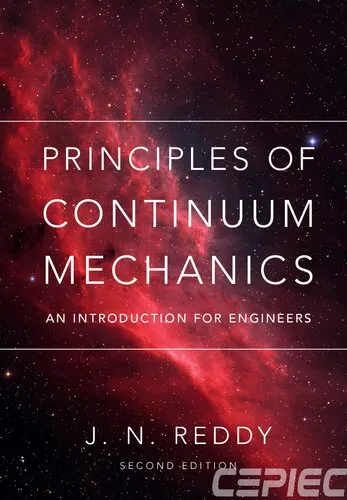
Principles of continuum mechanics: an introduction for engineers
J.N. Reddy
English
Beginner
Engineering
4.9 / 5
0 reviews
2017
Published
274
pages
187
views
Introduction to "Principles of Continuum Mechanics: An Introduction for Engineers" Engineering fields often require a solid grasp of mechanics to model and solve physical problems. Written for engineers and advanced students, "Principles of Continuum Mechanics: An Introduc
Before you read
What will you get from this book?
Introduction to "Principles of Continuum Mechanics: An Introduction for Engineers"
Engineering fields often require a solid grasp of mechanics to model and solve physical problems. Written for engineers and advanced students, "Principles of Continuum Mechanics: An Introduction for Engineers" by J.N. Reddy is a comprehensive guide focused on the fundamentals of continuum mechanics. This book serves as a bridge for those transitioning from undergraduate-level courses to advanced mechanics concepts required in research or industry applications.
The book emphasizes a mathematical and physical understanding of continuum mechanics and establishes a connection between classical mechanics and more advanced theories like thermomechanics, non-linear elasticity, and fluid mechanics. In the chapters that follow, the reader will find clear explanations, illustrative examples, and practical problem-solving approaches that make this text a versatile resource for self-study or as part of academic coursework.
Detailed Summary of the Book
The book begins by addressing the foundational concepts of continuum mechanics, providing insights into the behavior of solids and fluids under various forces and constraints. Starting with basic definitions and framework, it introduces the reader to the concepts of tensors, stress, strain, and deformation — vital tools for modeling and analyzing material behavior.
The early chapters establish the basis of continuum mechanics, such as kinematics and conservation laws, using systematic mathematical derivations. A notable strength lies in its balance between theoretical rigor and practical applicability, ensuring that engineers with varying levels of mathematical expertise can follow the material effectively.
The intermediate chapters delve into advanced topics like linear elasticity, constitutive models, and material symmetry. The principles of energy methods are also discussed, making the book particularly valuable for structural and aerospace engineers. Fluid mechanics and thermodynamics applications are addressed, giving a well-rounded perspective critical for interdisciplinary fields.
In addition to theory, the book emphasizes numerical methods, such as finite element formulations, bridging the equations of continuum mechanics with computational tools widely used in engineering design and analysis. This feature allows engineers to transition from pure mathematical formulations to real-world modeling and simulation scenarios.
Key Takeaways
- Comprehensive Understanding: The book provides a thorough explanation of the fundamental principles governing solids and fluids, preserving a balance between classical mechanics and modern computational methods.
- Mathematical Rigor: A detailed exploration of tensor calculus and mathematical models relevant to continuum mechanics forms the backbone of the text.
- Practical Problem Solving: With illustrative examples and real-world applications, the book equips readers with computational tools and techniques for solving engineering problems.
- Interdisciplinary Approach: Topics such as thermomechanics, fluid mechanics, and energy methods are included, making the book suitable for engineers in structural, mechanical, civil, and aerospace disciplines.
- Well-Structured Learning: The logical progression from first principles to advanced theories allows for both self-paced learning and classroom adoption.
Famous Quotes from the Book
"At its core, continuum mechanics enables us to describe nature’s complexities using elegant and compact mathematical principles."
"The transition from the discrete to the continuum is not merely a mathematical abstraction; it is the essence of understanding physical phenomena."
Why This Book Matters
Understanding the principles of continuum mechanics is essential for engineers involved in modeling, simulation, and analysis of materials and structures. J.N. Reddy's book is particularly significant because it not only explains the underlying theoretical principles but also makes a concerted effort to connect this understanding with real-world engineering applications — a distinguishing factor in an era dominated by computational tools and complexity in design processes.
What sets this book apart is its holistic approach to mechanics. From theoretical motivations behind field equations to their practical implications in finite element models, the book ensures engineers are equipped with the skills necessary to solve complex physical problems. Furthermore, Reddy’s clarity in explaining rigorous mathematics strengthens its accessibility to students and professionals alike, while its focus on practical engineering challenges ensures relevancy across industries.
For academic institutions, researchers, and practicing engineers alike, "Principles of Continuum Mechanics: An Introduction for Engineers" remains a cornerstone resource. Its ability to connect intuition with mathematical precision exemplifies the nature of engineering as both an art and a science.
Ask this book
Your question is answered in the context of this title and author. Each answer uses 2 points.
Sign in to ask the book assistant.
Reader reviews
0 reviews, 4.9 average out of 5
No reviews yet
If you have read this book, help the next reader with your experience.
Write a review
Sign in to publish a review.
Reader questions and answers
Ask a focused question and learn from the community.
Sign in to ask or answer a question.
No questions yet
Be the first to ask a clear, useful question.
What to read next
Related references that continue this learning path.


Modern Computer Vision with PyTorch: A Practical Roadmap From Deep Learning Fundamentals to Advanced Applications and Generative AI, 2nd Edition
V Kishore Ayyadevara,Yeshwanth Reddy
2023
View book