

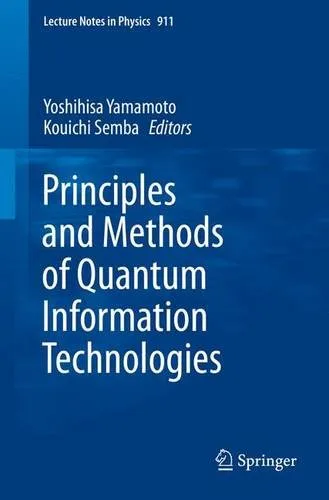
Book guide and evaluation
Principles and Methods of Quantum Information Technologies
Yoshihisa Yamamoto,Kouichi Semba
English
Beginner
Software Engineering
4.2 / 5
0 reviews
2016
Published
615
pages
173
views
Introduction to Principles and Methods of Quantum Information Technologies The book Principles and Methods of Quantum Information Technologies offers a comprehensive exploration into the theoretical and practical applications of quantum information science. Written by leading
Before you read
What will you get from this book?
Introduction to Principles and Methods of Quantum Information Technologies
The book Principles and Methods of Quantum Information Technologies offers a comprehensive exploration into the theoretical and practical applications of quantum information science. Written by leading experts in the field, Yoshihisa Yamamoto and Kouichi Semba, this transformative text bridges the gap between physics, computer science, and engineering. It serves as an essential guide to understanding and leveraging the next generation of computational systems and information technologies built upon the fascinating principles of quantum mechanics.
As we enter the quantum era, where quantum computers and quantum communication systems head toward real-world applications, the book provides a careful balance of technical rigor and accessibility. It systematically unpacks the foundational theories, cutting-edge technologies, and methods that drive quantum information science. Whether you are a researcher delving into quantum computing, an engineer exploring its applications, or simply a curious mind fascinated by quantum systems, the book is designed to expand your worldview.
Detailed Summary of the Book
This book systematically introduces readers to the principles, experimental techniques, and emerging trends in quantum information technologies.
The book is divided into key sections, beginning with the fundamental concepts of quantum mechanics, such as superposition, entanglement, and quantum state measurement. It provides a firm grounding in abstraction, offering mathematical frameworks like density matrices and quantum gates that underlie quantum computing. Then, it transitions to discuss various models of quantum information processing, including quantum computation, quantum communication, and quantum cryptography.
The intermediate chapters focus on technologies such as quantum logic circuits, quantum error correction techniques, and physical implementations of qubits. Readers gain insight into the architectures of quantum computers, from superconducting qubits to photonic systems, and learn about technical hurdles like decoherence and noise suppression.
Finally, the book takes an interdisciplinary turn, illustrating how quantum technology integrates with other scientific domains, such as quantum chemistry, quantum simulation, and artificial intelligence. These broader discussions tie quantum theories to practical use cases, emphasizing the technology's potential to revolutionize fields like drug discovery, secure communication, and optimization problems.
Key Takeaways
The book is a treasure trove of insights into one of the most transformative scientific fields of the 21st century. Here are some key takeaways:
- Quantum mechanics is the foundation of novel technologies that outperform classical systems in computation and communication.
- Superposition and entanglement enable quantum systems to process and share information in unique ways.
- Practical challenges like decoherence and noise require robust error correction methods and fault-tolerant designs.
- Quantum computing has profound implications for industries such as cryptography, artificial intelligence, and materials science.
- Interdisciplinary collaboration is key to realizing the full potential of quantum information technologies.
Famous Quotes from the Book
Here are some thought-provoking quotes from the text:
"Quantum mechanics does not just describe the universe; it allows us to reimagine the limits of technology."
"The interplay between theory and experimentation is at the heart of quantum information science, shaping the future of computation and security."
"Quantum information technologies represent the culmination of decades of research into understanding the fundamental laws of nature."
Why This Book Matters
Quantum information technologies are not just the future—they are the present.
This book is crucial for anyone looking to understand how quantum principles are translated into groundbreaking tools that have the power to disrupt industries and solve problems deemed intractable by classical means. It serves as a springboard for educators, researchers, and professionals to engage with quantum science and inspire the next wave of innovation. In a world where quantum systems are quickly moving toward commercialization, understanding these principles is not just an intellectual pursuit but an economic and societal imperative.
Moreover, as the development of quantum technologies gains momentum globally, this book highlights the importance of a multidisciplinary approach, combining advances in physics, computer science, and engineering. It enables readers to grasp the broad implications of quantum systems for cybersecurity, national defense, healthcare, and beyond.
Overall, Principles and Methods of Quantum Information Technologies is not just a textbook—it is an essential part of the conversation about the quantum revolution that is reshaping the world.
Ask this book
Your question is answered in the context of this title and author. Each answer uses 2 points.
Sign in to ask the book assistant.
Reader reviews
0 reviews, 4.2 average out of 5
No reviews yet
If you have read this book, help the next reader with your experience.
Write a review
Sign in to publish a review.
Reader questions and answers
Ask a focused question and learn from the community.
Sign in to ask or answer a question.
No questions yet
Be the first to ask a clear, useful question.
What to read next
Related references that continue this learning path.



Modern Computer Vision with PyTorch: A Practical Roadmap From Deep Learning Fundamentals to Advanced Applications and Generative AI, 2nd Edition
V Kishore Ayyadevara,Yeshwanth Reddy
2023
View book