
Book guide and evaluation
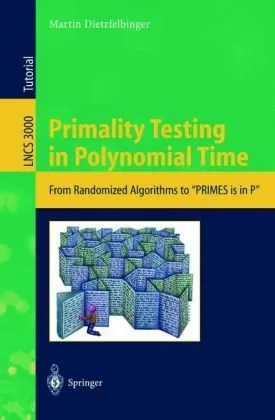
Primality Testing in Polynomial Time: From Randomized Algorithms to "PRIMES Is in P"
Martin Dietzfelbinger (auth.)
English
Beginner
Mathematics
4.6 / 5
0 reviews
2004
Published
152
pages
225
views
Introduction to "Primality Testing in Polynomial Time: From Randomized Algorithms to 'PRIMES Is in P'" The study and exploration of prime numbers have long held a central position in mathematics, their enigmatic nature challenging both amateurs and experts alike.
Before you read
What will you get from this book?
Introduction to "Primality Testing in Polynomial Time: From Randomized Algorithms to 'PRIMES Is in P'"
The study and exploration of prime numbers have long held a central position in mathematics, their enigmatic nature challenging both amateurs and experts alike. "Primality Testing in Polynomial Time" delves deeply into the nuanced world of prime number testing, presenting a compelling journey from the early days of randomized primality-testing algorithms to the groundbreaking discovery that "PRIMES is in P". This book provides a detailed and interconnected narrative that is both an academic exploration and an authoritative resource for computer scientists, mathematicians, and students captivated by computational number theory.
The question of whether a given number is prime is not only a fascinating theoretical problem but also a cornerstone of modern cryptography and computer science. This book gives readers not only the mathematical frameworks but also the historical and computational contexts to fully grasp the development of primality testing into its current efficient and deterministic form. Richly detailed yet accessible, this book serves both as a reference and an educational tool, balancing clarity with mathematical rigor to ensure readers with varied levels of expertise can engage with its subject matter.
Detailed Summary of the Book
"Primality Testing in Polynomial Time" is organized to cater to both newcomers and advanced readers interested in computational mathematics. The text begins with the historical significance of prime numbers, delving into their applications and the earliest attempts at testing primality. It presents an extensive discussion on the early randomized algorithms, such as the Solovay-Strassen, Miller-Rabin, and earlier deterministic approaches like trial division.
The book's major focus converges on the celebrated AKS primality test, developed by Agrawal, Kayal, and Saxena in 2002. The AKS algorithm was the first to conclusively prove that primality testing could be performed in deterministic polynomial time — an achievement encapsulated in the claim that "PRIMES is in P". Through careful and stepwise exposition, the book explores the mathematical insights, computational principles, and proofs underpinning the AKS algorithm.
Moreover, the book highlights the practical implications of these findings in areas like cryptographic security and computational efficiency. It examines related techniques and their implementation, inviting readers to understand how the theoretical breakthroughs translate into real-world applications, such as secure communication and cryptographic protocols.
Key Takeaways
- An in-depth understanding of the journey from randomized to deterministic algorithms in primality testing.
- Detailed exploration and proof of the AKS primality test, demonstrating that "PRIMES is in P".
- A broader context linking algorithm design to cryptographic applications.
- Insights into the mathematical and theoretical frameworks that paved the way for subsequent algorithmic advances.
- A balanced approach catering to readers with varying familiarity with computational number theory.
Famous Quotes from the Book
"Prime numbers are the heartbeat of mathematics, their unyielding regularity charting the course of centuries of intellectual curiosity."
"To determine primality is not merely a mathematical exercise; it is a testament to the power of computational ingenuity."
Why This Book Matters
The discovery that "PRIMES is in P" was a groundbreaking milestone that profoundly impacted computational mathematics and theoretical computer science. It revolutionized how we understand questions of primality and efficiency, building a bridge between pure mathematical theory and real-world computational applications. This book is more than an academic treatise — it is a chronicle of one of the finest achievements in the history of algorithms, demonstrating how an age-old problem inspired a new era of discovery.
The themes explored in this book resonate far beyond the realm of primality testing. They underscore the ingenuity of mathematical minds and the persistence required to transform an idea into a definitive proof. By presenting these breakthroughs in an accessible and structured manner, the book ensures that this knowledge is not confined to a privileged few but shared with a broader audience, fueling curiosity and inspiration for future discoveries.
Ask this book
Your question is answered in the context of this title and author. Each answer uses 2 points.
Sign in to ask the book assistant.
Reader reviews
0 reviews, 4.6 average out of 5
No reviews yet
If you have read this book, help the next reader with your experience.
Write a review
Sign in to publish a review.
Reader questions and answers
Ask a focused question and learn from the community.
Sign in to ask or answer a question.
No questions yet
Be the first to ask a clear, useful question.
What to read next
Related references that continue this learning path.

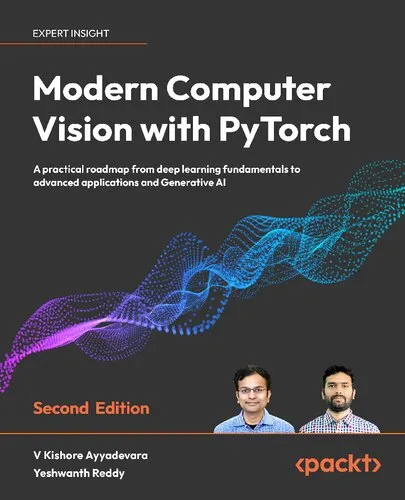
Modern Computer Vision with PyTorch: A Practical Roadmap From Deep Learning Fundamentals to Advanced Applications and Generative AI, 2nd Edition
V Kishore Ayyadevara,Yeshwanth Reddy
2023
View book