Practical Troubleshooting of Electrical Equipment and Control Circuits
Mark Brown, Jawahar Rawtani M.Sc(Tech) MBA, Dinesh Patil B.E (I&C) DipEE
2005
View book
Book guide and evaluation
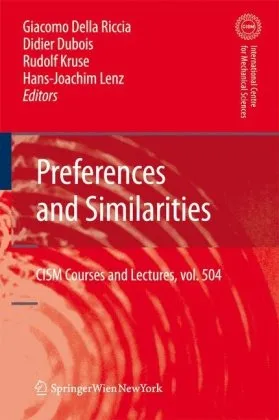
Giacomo Riccia,Didier Dubois,Hans-Joachim Lenz,Rudolf Kruse
0 reviews
Published
pages
views
Preferences and Similarities: A Comprehensive Exploration "Preferences and Similarities," part of the esteemed CISM International Centre for Mechanical Sciences series, delves into the intricate world of decision-making and classification. Authored by Giacomo Riccia, Did
Before you read
"Preferences and Similarities," part of the esteemed CISM International Centre for Mechanical Sciences series, delves into the intricate world of decision-making and classification. Authored by Giacomo Riccia, Didier Dubois, Hans-Joachim Lenz, and Rudolf Kruse, this book is an essential resource for researchers, academics, and practitioners seeking deeper insights into preference modeling and similarity assessment. By combining theoretical foundations, practical methodologies, and real-world applications, this scholarly work offers a multidimensional view of concepts that govern both human and machine decision-making processes.
At its core, "Preferences and Similarities" examines two fundamental aspects of decision-making systems: preferences and the concept of similarity. These constructs are pivotal for modeling phenomena ranging from individual decision-making to broader computational systems such as artificial intelligence and machine learning algorithms.
The book begins by discussing preference modeling, where the authors present mathematical frameworks for capturing and representing user preferences across various domains. Whether it's a consumer choosing between products or a recommendation system personalizing suggestions, preferences are inherently complex and subjective. The authors break down the logic and techniques necessary to quantify and analyze these subjective choices.
Next, the text dives into the realm of similarity, exploring how entities can be compared, grouped, and classified based on shared attributes. Topics such as fuzzy logic, probabilistic reasoning, and machine learning algorithms are thoroughly explored to demonstrate how similarity assessments are applied in modern-day technology and systems.
Practical examples and applied methodologies are interwoven throughout the book, making theoretical concepts accessible and actionable. From clustering techniques in data analysis to advanced preference-based decision-making tools, the content is designed to cater to a diverse audience of learners. By the end of the book, readers will have a strong understanding of how preference modeling and similarity assessment play crucial roles in solving complex problems in mechanical sciences and beyond.
“Preferences and similarities are the cornerstones of both human intuition and computational intelligence, bridging subjective values with actionable metrics.”
“Understanding preference is more than grasping choice—it’s about building systems that respect human complexity.”
“Similarity is not just a way to compare entities; it’s a foundation for clustering, association, and knowledge extraction.”
In an era where technology continues to advance at an incredible pace, understanding how preferences and similarity metrics operate is fundamental to shaping intelligent systems. Whether it's personalizing user experiences or clustering vast datasets for actionable insights, these concepts are indispensable to the modern world. "Preferences and Similarities" stands out as a definitive resource that brings together rigorous academic research and cutting-edge applications to simplify complex ideas.
This book does more than just educate—it inspires innovation by equipping researchers, engineers, and decision-makers with the tools to handle nuanced problems. Its depth, clarity, and emphasis on practicality make it uniquely valuable not just to the domain of mechanical sciences, but also to allied fields such as artificial intelligence, data science, and operational research. Whether you're a scholar looking to deepen your understanding or a practitioner in search of advanced tools, this book is a cornerstone for anyone invested in the interplay of human preferences and systematic decision-making.
Your question is answered in the context of this title and author. Each answer uses 2 points.
0 reviews, 4.5 average out of 5
Sign in to publish a review.
Ask a focused question and learn from the community.
Related references that continue this learning path.
Mark Brown, Jawahar Rawtani M.Sc(Tech) MBA, Dinesh Patil B.E (I&C) DipEE

Volker Weitbrecht