Book guide and evaluation
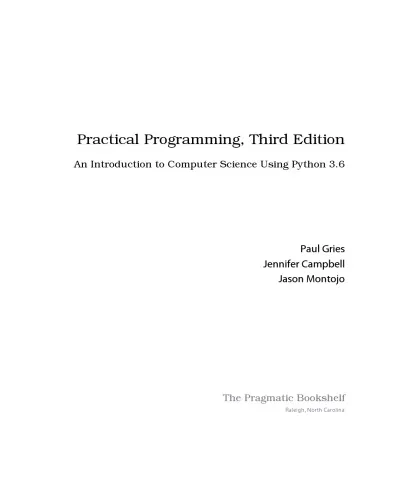
Practical Programming: An Introduction to Computer Science Using Python 3.6
Paul Gries,Jennifer Campbell,Jason Montojo
English
Unordered
Computer Science and Theory
4.5 / 5
0 reviews
2017
Published
397
pages
624
views
Introduction to Practical Programming Python is not just a programming language; it's a gateway to understanding the world of computer science. "Practical Programming: An Introduction to Computer Science Using Python 3.6" serves as an essential guide for beginners who have
Before you read
What will you get from this book?
Introduction to Practical Programming
Python is not just a programming language; it's a gateway to understanding the world of computer science. "Practical Programming: An Introduction to Computer Science Using Python 3.6" serves as an essential guide for beginners who have no prior programming experience. This book effectively simplifies complex concepts, making them accessible to newcomers while providing a solid foundation in problem-solving skills and computational thinking.
Detailed Summary of the Book
"Practical Programming" is meticulously crafted to introduce Python programming through an engaging narrative that combines theoretical concepts and hands-on exercises. The book begins with the basics, such as understanding data types and control structures, progressively moving towards more advanced topics like functions, file handling, and object-oriented programming. The authors, Paul Gries, Jennifer Campbell, and Jason Montojo, use their vast teaching experience to focus on the development of fundamental programming techniques.
The book is structured to integrate examples and exercises directly with the text, promoting an interactive learning experience. This approach ensures that readers not only comprehend the concepts but also apply them practically, solidifying their understanding through real-world applications. By the end of the book, readers have a robust understanding of Python and possess the skills needed to tackle more complex programming challenges.
Key Takeaways
- Learn by Doing: Each chapter includes programming exercises that reinforce the material, encouraging readers to apply what they've learned immediately.
- Comprehensive Coverage: The book covers a wide range of topics, from the basics of Python syntax to more complex concepts such as inheritance and recursion.
- Practical Examples: Real-life applications of programming are integrated, providing a context for how programming is used in various fields.
- Develop Problem-Solving Skills: The emphasis on computational thinking aids readers in developing techniques for solving diverse problems logically.
Famous Quotes from the Book
"Programming isn't about what you know; it's about what you can figure out."
"Learning to program is learning to think and learning to think like a programmer."
Why This Book Matters
In today's tech-driven world, programming is considered a fundamental skill across various domains. "Practical Programming" addresses the growing demand for technical proficiency by equipping readers with essential skills. The book's approachable style is suitable for students, hobbyists, and professionals looking to broaden their expertise in programming.
Unlike many other programming books that focus solely on code, this book advocates for a deep understanding of underlying principles. By fostering problem-solving and analytical thinking, "Practical Programming" prepares readers to not only write functional code but also to adapt to new programming languages and paradigms across their careers.
By integrating theoretical learning with practical application, readers are not only able to write code effectively but are also encouraged to explore and innovate. This book serves as the ideal starting point for anyone willing to delve into the world of Python and computer science.
Ask this book
Your question is answered in the context of this title and author. Each answer uses 2 points.
Sign in to ask the book assistant.
Reader reviews
0 reviews, 4.5 average out of 5
No reviews yet
If you have read this book, help the next reader with your experience.
Write a review
Sign in to publish a review.
Reader questions and answers
Ask a focused question and learn from the community.
Sign in to ask or answer a question.
No questions yet
Be the first to ask a clear, useful question.
What to read next
Related references that continue this learning path.
How to think like a computer scientist: learning with python
Allen B. Downey,Jeffrey Elkner,Chris Meyers
2002
View book