
Book guide and evaluation
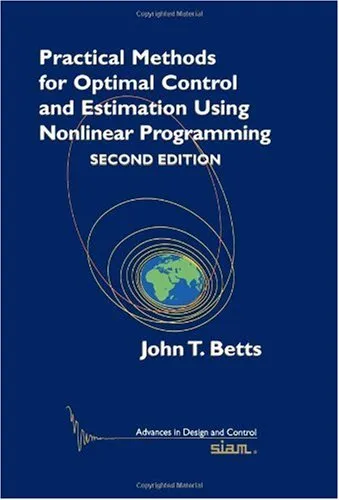
Practical methods for optimal control and estimation using nonlinear programming
Betts J.T.
English
Beginner
Mathematics
4.6 / 5
0 reviews
2010
Published
449
pages
231
views
Introduction to "Practical Methods for Optimal Control and Estimation Using Nonlinear Programming" "Practical Methods for Optimal Control and Estimation Using Nonlinear Programming" is a pivotal text in the field of optimization and control systems engineering. Written by Bett
Before you read
What will you get from this book?
Introduction to "Practical Methods for Optimal Control and Estimation Using Nonlinear Programming"
"Practical Methods for Optimal Control and Estimation Using Nonlinear Programming" is a pivotal text in the field of optimization and control systems engineering. Written by Betts J.T., this book dives deep into state-of-the-art techniques, exploring how nonlinear programming methods can be effectively employed to solve complex optimal control problems. It brings theory, algorithms, and practical implementation together in a seamless way, enabling both beginners and advanced practitioners to engage with the challenges of optimization and estimation in real-world systems.
This book acts as a bridge between mathematical rigor and practical applications. It addresses key challenges in fields such as aerospace, robotics, artificial intelligence, and industrial automation, where systems governed by nonlinear differential equations demand precise optimization. With a focus on computational feasibility, this text emphasizes practical, real-world results over mere theoretical derivations, making it particularly vital for engineers and researchers.
Detailed Summary of the Book
The book begins by introducing fundamental concepts of optimal control and estimation, ensuring even readers with a basic understanding can follow its ideas. It systematically progresses to discuss advanced strategies for applying nonlinear programming (NLP) methods to a wide variety of problems. The central thesis revolves around understanding how constrained optimization techniques can transform a complex optimal control or parameter estimation problem into a solvable mathematical framework.
Importantly, the book outlines the theory behind direct methods—particularly transcription techniques—for solving nonlinear optimal control problems. These direct methods discretize continuous time and space to create a finite-dimensional optimization problem amenable to modern solvers. From this foundation, readers are introduced to popular NLP solvers, convergence criteria, and computational techniques to improve efficiency and accuracy.
Another pivotal chapter deals with sensitivity analysis, which is critical for understanding how errors or disturbances propagate through dynamic systems. Estimation techniques, such as the treatment of measurement noise and Kalman filtering, are explained in a pedagogic yet practical fashion. The book also includes discussions on robustness, numerical implementation, and case studies demonstrating how these techniques can be applied across various industries.
Key Takeaways
- Comprehensive exploration of direct methods for solving nonlinear optimal control problems.
- Practical approaches to handling nonlinearity, constraints, and noise in estimation problems.
- Step-by-step guidance on the use of transcription methods in conjunction with nonlinear programming solvers.
- Insights into the numerical behavior of optimization methods, focusing on stability and computational efficiency.
- Case studies spanning aerospace systems, robotics, and other engineering disciplines.
Famous Quotes from the Book
"The successful application of an optimal control method relies not only on the theory but also on the implementation of efficient and robust numerical algorithms."
"Finding the optimal solution is not sufficient; understanding its sensitivity to system dynamics and disturbances is equally vital."
"Direct methods capitalize on modern computational techniques to make optimal control feasible for real-world nonlinear systems."
Why This Book Matters
This book is a cornerstone resource for anyone studying or working in optimal control and estimation. Unlike many theoretical texts, it provides actionable guidance for implementing algorithms to solve practical engineering problems. The author's ability to distill complex mathematical principles into computational strategies makes this work indispensable. It goes beyond being just a textbook—it's a guide that addresses the challenges engineers face in today’s dynamic and interconnected world of systems design.
Moreover, the emphasis on nonlinear programming and direct methods reflects the evolution of control systems, as many modern problems cannot be approximated by linear models. With the increasing reliance on computational tools, Betts J.T. brings clarity and practicality to a field often perceived as overly complex or inaccessible. This book empowers readers not only to understand the theoretical underpinnings but also to confidently tackle the nuances of real-world applications, making it a must-have for professionals and students alike.
Ask this book
Your question is answered in the context of this title and author. Each answer uses 2 points.
Sign in to ask the book assistant.
Reader reviews
0 reviews, 4.6 average out of 5
No reviews yet
If you have read this book, help the next reader with your experience.
Write a review
Sign in to publish a review.
Reader questions and answers
Ask a focused question and learn from the community.
Sign in to ask or answer a question.
No questions yet
Be the first to ask a clear, useful question.
What to read next
Related references that continue this learning path.
Modern Computer Vision with PyTorch: A Practical Roadmap From Deep Learning Fundamentals to Advanced Applications and Generative AI, 2nd Edition
V Kishore Ayyadevara,Yeshwanth Reddy
2023
View book