
Book guide and evaluation
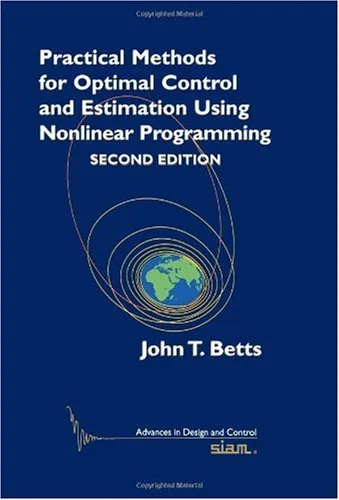
Practical Methods for Optimal Control and Estimation Using Nonlinear Programming, Second Edition (Advances in Design and Control)
John T. Betts
English
Beginner
Mathematics
4.7 / 5
0 reviews
2009
Published
449
pages
161
views
Introduction to "Practical Methods for Optimal Control and Estimation Using Nonlinear Programming, Second Edition" The book, Practical Methods for Optimal Control and Estimation Using Nonlinear Programming, Second Edition, is designed as a comprehensive guide to the principles
Before you read
What will you get from this book?
Introduction to "Practical Methods for Optimal Control and Estimation Using Nonlinear Programming, Second Edition"
The book, Practical Methods for Optimal Control and Estimation Using Nonlinear Programming, Second Edition, is designed as a comprehensive guide to the principles and applications of optimal control and estimation through the lens of nonlinear programming techniques. In this seminal work, I, John T. Betts, present a detailed exposition of advanced numerical methods and algorithms tailored to solving complex real-world problems in engineering, physics, economics, and other scientific domains.
With the rapid evolution of computational tools and techniques, solving nonlinear optimization problems has become not only possible but also essential in many practical applications. This book aims to bridge the gap between theoretical optimal control frameworks and their actual implementation using state-of-the-art nonlinear programming methods. Whether you're a seasoned researcher, an applied mathematician, or a graduate student, this book serves as an essential resource for understanding and implementing optimal control techniques effectively.
Detailed Summary of the Book
The book begins by laying a strong theoretical foundation for optimal control and nonlinear programming. The introductory chapters guide readers through the fundamental concepts of control theory, including dynamic systems, sensitivity analysis, and necessary optimality conditions. Building on this foundation, the book delves into key topics such as the formulation of optimal control problems, direct and indirect solution methods, and the role of constraints in real-world scenarios.
One of the core strengths of this book is its emphasis on practical implementation. The second edition expands upon its predecessor by introducing new numerical algorithms and enhanced techniques for solving large-scale, nonlinear problems. Numerical examples are interspersed throughout, allowing readers to observe and understand the application of these concepts in detail. The text also integrates discussions on state estimation and filtering, enabling readers to appreciate the synergy between optimal control and estimation in dynamic system settings.
Each chapter concludes with carefully curated exercises and references, encouraging readers to test their understanding and explore cutting-edge research in the field. The second edition also includes updated MATLAB implementations to provide hands-on learning opportunities. These resources make the book an invaluable asset for both theoretical study and practical problem-solving.
Key Takeaways
- A robust introduction to the basics of optimal control and nonlinear programming.
- Comprehensive coverage of direct and indirect methods for solving optimal control problems.
- Step-by-step illustrations of practical numerical techniques for real-world applications.
- An exploration of state estimation and filtering as it pertains to dynamic systems.
- Insights into the integration of theory and computational tools, including MATLAB examples.
Famous Quotes from the Book
"Optimal control is not just about finding the best trajectory or decision sequence—it’s about doing so under the constraints of a real-world system."
"The elegance of nonlinear programming lies in its ability to translate complexity into solvability, provided one has the right tools."
Why This Book Matters
Optimal control and estimation are at the forefront of technological innovation. From autonomous vehicles to aerospace trajectory optimization, these techniques are critical to solving increasingly complex engineering challenges. Yet, these problems are rarely solvable without leveraging modern nonlinear programming methods.
This book stands at the intersection of theory and practice, offering a lucid explanation of fundamental principles alongside meticulously detailed implementation strategies. By emphasizing a practical approach, the book empowers researchers, academia, and industry professionals alike to bridge the gap between abstract mathematics and applied solutions. Its broad scope and attention to clarity make it a timeless resource for solving some of today’s most pressing engineering problems.
Furthermore, the second edition reflects advancements in computation, addressing the needs and challenges of modern users. This makes the book not only a foundational guide but also a current and relevant reference in the field of optimal control and estimation.
Ask this book
Your question is answered in the context of this title and author. Each answer uses 2 points.
Sign in to ask the book assistant.
Reader reviews
0 reviews, 4.7 average out of 5
No reviews yet
If you have read this book, help the next reader with your experience.
Write a review
Sign in to publish a review.
Reader questions and answers
Ask a focused question and learn from the community.
Sign in to ask or answer a question.
No questions yet
Be the first to ask a clear, useful question.
What to read next
Related references that continue this learning path.
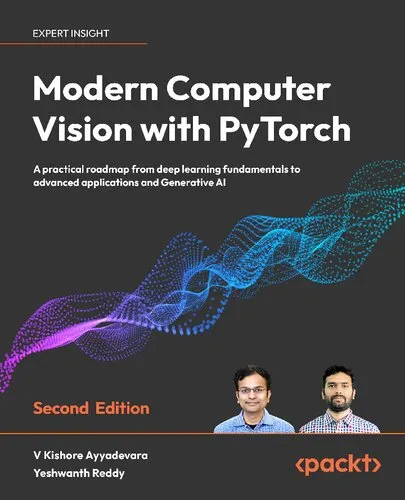
Modern Computer Vision with PyTorch: A Practical Roadmap From Deep Learning Fundamentals to Advanced Applications and Generative AI, 2nd Edition
V Kishore Ayyadevara,Yeshwanth Reddy
2023
View book