Book guide and evaluation
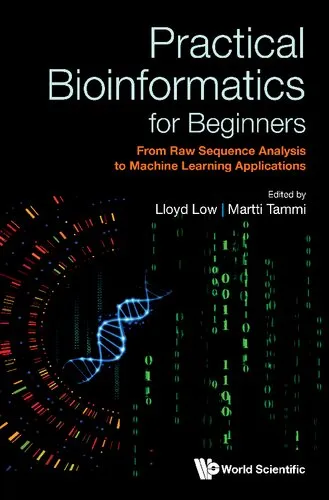
Practical Bioinformatics for Beginners: From Raw Sequence Analysis to Machine Learning Applications
Lloyd Wai Yee Low,Martti Tapani Tammi
English
Beginner
Machine Learning
4.0 / 5
0 reviews
2023
Published
268
pages
449
views
Introduction to "Practical Bioinformatics for Beginners: From Raw Sequence Analysis to Machine Learning Applications" Welcome to the world of bioinformatics, where the mysteries of biology are unraveled through the lens of computational analysis. "Practical Bioinformatics
Before you read
What will you get from this book?
Introduction to "Practical Bioinformatics for Beginners: From Raw Sequence Analysis to Machine Learning Applications"
Welcome to the world of bioinformatics, where the mysteries of biology are unraveled through the lens of computational analysis. "Practical Bioinformatics for Beginners" is a hands-on guide designed to help readers transition from raw biological data to advanced machine learning applications. Written with clarity and precision, this book bridges the traditional divide between biology and computer science, making it a perfect companion for both newcomers and intermediate learners.
Bioinformatics is not just about algorithms and data — it’s about making sense of life at a molecular level. This book serves as an essential resource for students, researchers, and hobbyists, offering step-by-step instructions to navigate through sequence analysis, data visualization, and predictive modeling. Whether you're just starting out in bioinformatics or looking to add machine learning tools to your toolkit, this book provides a clear pathway to mastering these topics.
Detailed Summary of the Book
The book begins by introducing readers to the fundamentals of bioinformatics, emphasizing the importance of biological sequences such as DNA, RNA, and proteins. Detailed yet easy-to-follow explanations are provided on topics like sequence alignment, database searches, and pattern recognition. Chapters are structured to include relevant examples that bridge the gap between theory and practice.
As readers progress, they’ll delve into more advanced topics such as high-throughput sequencing data, feature extraction, and data preprocessing techniques. The book doesn’t stop there — it boldly ventures into modern applications of machine learning in bioinformatics. Key concepts in supervised and unsupervised learning are discussed, along with practical applications such as phenotype prediction, clustering, and classification of biological data.
Hands-on examples in Python and R make complex algorithms accessible, while exercises at the end of each chapter ensure readers can confidently apply what they’ve learned. By the final chapter, readers will have built their own bioinformatics pipelines and machine learning models, ready to tackle real-world challenges in computational biology.
Key Takeaways
- Understand the foundational principles of bioinformatics and sequence analysis.
- Learn practical skills for handling biological data, from nucleotide sequences to protein datasets.
- Gain proficiency in using tools and programming languages like Python and R for bioinformatics workflows.
- Explore modern applications of machine learning in areas like genomics, proteomics, and systems biology.
- Build end-to-end bioinformatics pipelines to tackle real-world research problems.
Famous Quotes from the Book
"Bioinformatics is not just the marriage of biology and computer science; it is the fusion of possibilities, where nature meets computation to decode the language of life."
"Every biological sequence carries a story. The role of bioinformatics is to uncover that story in a way that advances both science and society."
"Machine learning has become the telescope for modern biology — it allows us to see patterns and relationships we could never have imagined."
Why This Book Matters
Bioinformatics is central to many key developments in biology and medicine, from decoding complex genomes to developing personalized healthcare solutions. With the explosion of biological data in the post-genomic era, there is a growing need for professionals who can bridge biology and computational science. This book empowers readers with the skills needed to contribute meaningfully to this exciting field.
What sets this book apart is its practical approach. Instead of overwhelming readers with dense theory, it focuses on actionable knowledge and hands-on learning. Topics are broken down into digestible chapters filled with exercises, code snippets, and real-world applications. These practical insights make it the go-to resource for anyone looking to make a mark in bioinformatics.
In an age where artificial intelligence and big data are transforming the sciences, "Practical Bioinformatics for Beginners" is a timely guide to unlocking the potential of machine learning in biomedical research. Whether you’re exploring bioinformatics for the first time or seeking to expand your computational skillset, this book is an essential step in your journey.
Ask this book
Your question is answered in the context of this title and author. Each answer uses 2 points.
Sign in to ask the book assistant.
Reader reviews
0 reviews, 4.0 average out of 5
No reviews yet
If you have read this book, help the next reader with your experience.
Write a review
Sign in to publish a review.
Reader questions and answers
Ask a focused question and learn from the community.
Sign in to ask or answer a question.
No questions yet
Be the first to ask a clear, useful question.
What to read next
Related references that continue this learning path.
Spark: The Definitive Guide: Big Data Processing Made Simple
Bill (B.) Chambers,Matei (M.) Zaharia
2018
View book