IEEE Trial Use Standard for Application and Management of the Systems Engineering Process (IEEE Std 1220
Software Engineering Standards Committee of the IEEE Computer SociCODE: OS
1994
View book
Book guide and evaluation
Nasser Tleis
0 reviews
Published
pages
views
Welcome to an in-depth exploration of "Power Systems Modelling and Fault Analysis: Theory and Practice," a seminal work authored by Nasser Tleis. This book is a comprehensive guide designed to equip professionals, researchers, and students in the field of electrical enginee
Before you read
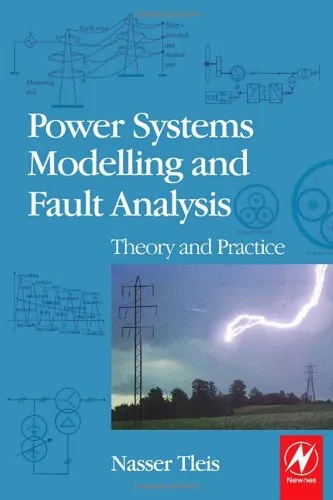
Welcome to an in-depth exploration of "Power Systems Modelling and Fault Analysis: Theory and Practice," a seminal work authored by Nasser Tleis. This book is a comprehensive guide designed to equip professionals, researchers, and students in the field of electrical engineering with advanced knowledge on power systems modeling and fault analysis. With a meticulous blend of theoretical foundations, practical applications, and industry-relevant examples, this book stands as an essential resource for anyone looking to deepen their understanding of power system dynamics.
"Power Systems Modelling and Fault Analysis" thoroughly examines the integral components of power systems and their interconnections, focusing primarily on modeling techniques and fault analysis methodologies. The book begins by laying the groundwork with fundamental concepts in power systems operation, delving into power generation, transmission, and distribution. From here, it transitions into more complex topics, providing detailed analyses of electrical circuits, control mechanisms, and system stability.
A significant portion of the text is dedicated to methodologies for fault analysis in power systems. This includes both balanced and unbalanced fault conditions, using tools such as symmetrical component theory. The author provides readers with robust mathematical models and computational techniques to effectively predict and analyze system responses to faults. Practical examples, along with case studies, offer insights into real-world applications and the impact of faults on the reliability and efficiency of power systems.
"The essence of power system analysis lies not only in understanding the theoretical foundations but also in mastering the application of these concepts to enhance the operation and resilience of the system."
"Fault analysis is not merely a technical challenge; it is a critical aspect of ensuring the reliability and safety of modern power networks."
In an era where power systems are becoming increasingly complex and interconnected, the need for sophisticated modeling and fault analysis is more pressing than ever. This book is vital for several reasons. It serves as a bridge between academic theory and practical application, offering readers the tools they need to navigate the challenges faced by today’s power systems engineers.
Moreover, as renewable energy sources and smart grid technologies are integrated into traditional power systems, understanding their impact on system dynamics and fault behavior becomes crucial. Nasser Tleis addresses these contemporary issues, preparing readers to engage with future challenges in power systems engineering.
Your question is answered in the context of this title and author. Each answer uses 2 points.
0 reviews, 4.5 average out of 5
Sign in to publish a review.
Ask a focused question and learn from the community.
Related references that continue this learning path.
Software Engineering Standards Committee of the IEEE Computer SociCODE: OS

Mary-Ann Dimand,Robert W Dimand