
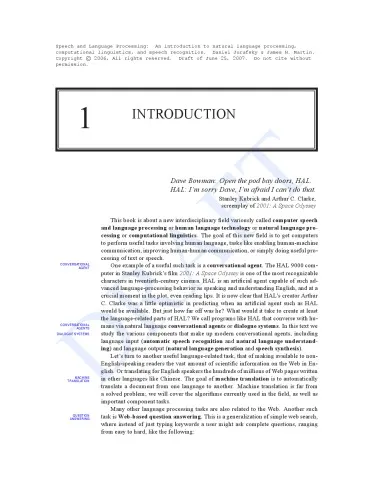
Speech and Language Processing: An Introduction to Natural Language Processing, Computational Linguistics, and Speech Recognition
Daniel Jurafsky,James H. Martin
2008
View book
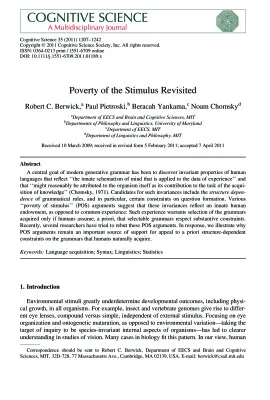
Book guide and evaluation
Berwick Robert C.,Pietroski Paul,Yankama Beracah,Chomsky Noam.
0 reviews
Published
pages
views
Introduction to "Poverty of the Stimulus Revisited" The concept of the Poverty of the Stimulus (POS) is a crucial cornerstone in the field of linguistics and cognitive science, shaping our understanding of how humans acquire language with seemingly limited exposure to comprehe
Before you read
The concept of the Poverty of the Stimulus (POS) is a crucial cornerstone in the field of linguistics and cognitive science, shaping our understanding of how humans acquire language with seemingly limited exposure to comprehensive linguistic information. "Poverty of the Stimulus Revisited," written by Berwick Robert C., Pietroski Paul, Yankama Beracah, and Chomsky Noam, offers an in-depth analysis and fresh perspectives on this enduring concept. This book is a critical exploration of the intrinsic mechanisms that allow humans to develop language abilities that far exceed the input received from their environment, challenging conventional theories and offering new insights into language acquisition.
The core aim of "Poverty of the Stimulus Revisited" is to address the apparent mismatch between the linguistic data available to language learners and the complex, rich grammatical structures they ultimately acquire. This book serves as a sequel to earlier works discussing this paradox, refining the argument that the language input (stimulus) children receive is insufficient to explain the linguistic competence they develop.
The authors embark on a journey to revisit and scrutinize the original POS arguments, integrating contemporary research from cognitive science, computational linguistics, and biology. They propose that there is an innate linguistic capacity in humans, shaped by evolutionary processes, that supports language acquisition. By combining theoretical elaborations with empirical data, they illustrate how language learning transcends mere inductive reasoning from available stimuli.
The book also explores alternative theories, contrasting the innate view with other hypotheses like statistical learning models. The authors examine these models critically, underscoring areas where they fall short of explaining the full complexity of language acquisition. Through a rigorous critique, they propose a more nuanced understanding of linguistic competence as a combination of innate principles and interactional experiences.
"Language is not a cultural artifact that we learn in the way we learn to tell time, or how the federal government works. Rather, it is a distinct piece of the biological makeup of our brains."
"Our ability to comprehend and produce language is contingent on the complex interplay between innate cognitive architectures and the linguistic environment."
"Poverty of the Stimulus Revisited" is significant due to its contribution to the ongoing conversation about how children acquire language and what that reveals about the human mind. In addressing fundamental questions about linguistic competence and the innate structures involved, this book challenges prevailing paradigms, inviting scholars to reconsider long-held beliefs.
Furthermore, the book's interdisciplinary approach, blending cognitive science, linguistics, and evolutionary theory, provides a comprehensive framework that offers new pathways for future research. It also stimulates critical thinking about the implications of language learning mechanisms on artificial intelligence and robotics, hinting at broader applications of these theories.
For those interested in the mysteries of the human mind, the mechanisms of language, and the frontiers of cognitive science, "Poverty of the Stimulus Revisited" is an essential read. It encapsulates the intellectual endeavors of its authors, pushing the boundaries of what it means to understand and replicate human language competence.
Your question is answered in the context of this title and author. Each answer uses 2 points.
0 reviews, 4.0 average out of 5
Sign in to publish a review.
Ask a focused question and learn from the community.
Related references that continue this learning path.
Daniel Jurafsky,James H. Martin

Graeme D. Kennedy