

Book guide and evaluation
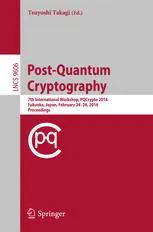
Post-Quantum Cryptography: 7th International Workshop, PQCrypto 2016, Fukuoka, Japan, February 24-26, 2016, Proceedings
Tsuyoshi Takagi (eds.)
English
Beginner
Software Engineering
4.4 / 5
0 reviews
2016
Published
276
pages
149
views
Introduction The field of cryptography is on the brink of a transformation as we shift toward the post-quantum era. The book Post-Quantum Cryptography: 7th International Workshop, PQCrypto 2016, Fukuoka, Japan, February 24-26, 2016, Proceedings captures this pivotal moment
Before you read
What will you get from this book?
Introduction
The field of cryptography is on the brink of a transformation as we shift toward the post-quantum era. The book Post-Quantum Cryptography: 7th International Workshop, PQCrypto 2016, Fukuoka, Japan, February 24-26, 2016, Proceedings captures this pivotal moment in detail. This comprehensive volume collects a wide range of research presented during the 7th International Workshop on Post-Quantum Cryptography held in the vibrant city of Fukuoka, Japan.
With advances in quantum computing threatening the security of classical cryptographic systems, this book consolidates innovative approaches and solutions from leading researchers worldwide. From lattice-based schemes to multivariate polynomial cryptosystems, the conference proceedings reflect the latest developments in securing digital communications and data in a post-quantum world.
This book serves as a crucial reference for cryptographers, security professionals, and academic researchers exploring the transition away from traditional cryptographic techniques to those that are secure against potential quantum attacks.
Detailed Summary of the Book
The book is a curated collection of peer-reviewed research papers presented during PQCrypto 2016. Collectively, these papers offer unparalleled insight into the latest advancements in post-quantum cryptography. The focus is on cryptographic protocols that address weaknesses in conventional systems exposed by quantum computing's sheer computational power.
The proceedings begin with an overview of the post-quantum cryptography landscape, setting the stage for more technical discussions. The topics range from foundational mathematical structures, such as lattices, codes, and hash functions, to practical implementations of cryptographic algorithms. Various designs of quantum-resistant public-key systems are discussed, including lattice-based cryptographic schemes, code-based systems, and multivariate cryptosystems.
Readers will also find research addressing the complexities of quantum key exchange mechanisms, signature schemes, and zero-knowledge proofs, ensuring the book covers a comprehensive array of topics. Each paper explores the feasibility of implementing these post-quantum solutions in real-world scenarios, focusing on performance, security, and practical concerns. Further, security reductions, performance benchmarks, and cryptanalysis are meticulously addressed, all with an eye toward identifying the strengths and weaknesses of specific techniques.
Key Takeaways
- Quantum computing poses a significant threat to classical cryptographic protocols, such as RSA, DSA, and ECC.
- Lattice-based cryptography emerged as a leading post-quantum candidate due to its strong security assumptions and high adaptability.
- Code-based cryptography and multivariate polynomial cryptosystems also show great promise, with specific strengths in signature schemes and encryption.
- Practical implementation of post-quantum schemes involves balancing security, computational complexity, and storage requirements.
- Collaboration across academia, industry, and government bodies is essential for a smooth transition into the post-quantum era.
Famous Quotes from the Book
"The advent of quantum computers may not be an immediate threat, but preparing for it is no longer optional—it is a necessity."
"Lattice problems offer a unique promise: the ability to withstand both classical and quantum attacks while enabling new cryptographic functionalities."
"We must emphasize practicality in selecting post-quantum cryptographic solutions, focusing not just on theoretical strength but also on real-world applicability."
Why This Book Matters
As society increasingly depends on digital technologies, ensuring the confidentiality, authenticity, and integrity of data is paramount. The rapid development of quantum computing poses a challenge to these critical assurances, as many widely used cryptographic algorithms are vulnerable to attacks by quantum computers. This book is not merely a compilation of research—it is a foundational text that addresses one of the most crucial security challenges of our time.
The importance of post-quantum cryptography cannot be overstated. With initiatives worldwide aiming to standardize post-quantum cryptographic techniques, the research contained in this book plays a vital role in shaping secure communication for decades to come. For policymakers, cryptographic implementers, and academic researchers alike, this book provides the theoretical and practical tools necessary to understand the quantum threat and develop robust solutions.
With its wide coverage of cutting-edge research, the book remains relevant for anyone interested in cryptography and security. Professionals involved in the transition toward quantum-resilient systems will find its insights and technical depth invaluable. It is both a milestone and a roadmap for navigating the complexities of post-quantum cryptography.
Ask this book
Your question is answered in the context of this title and author. Each answer uses 2 points.
Sign in to ask the book assistant.
Reader reviews
0 reviews, 4.4 average out of 5
No reviews yet
If you have read this book, help the next reader with your experience.
Write a review
Sign in to publish a review.
Reader questions and answers
Ask a focused question and learn from the community.
Sign in to ask or answer a question.
No questions yet
Be the first to ask a clear, useful question.
What to read next
Related references that continue this learning path.

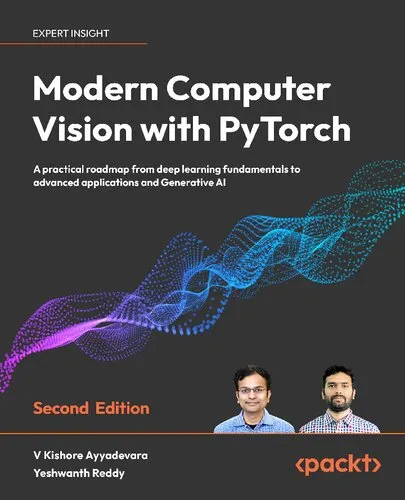
Modern Computer Vision with PyTorch: A Practical Roadmap From Deep Learning Fundamentals to Advanced Applications and Generative AI, 2nd Edition
V Kishore Ayyadevara,Yeshwanth Reddy
2023
View book