Book guide and evaluation
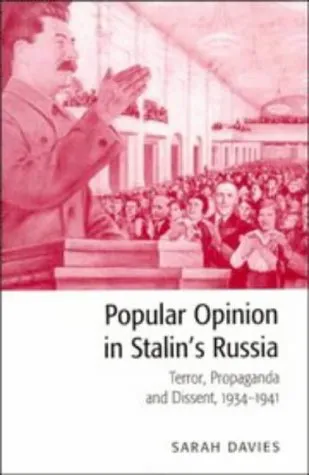
Popular Opinion in Stalin's Russia: Terror, Propaganda and Dissent, 1934-1941
Sarah Davies
English
Unordered
Historical
4.3 / 5
0 reviews
1997
Published
127
pages
258
views
Popular Opinion in Stalin's Russia: Terror, Propaganda and Dissent, 1934-1941 Soviet public opinion, Stalinist propaganda In-depth study of Popular Opinion in Stalin's Russia: Terror, Propaganda and Dissent, 1934-1941 exploring fear, ideology, and resistance. Analyti
Before you read
What will you get from this book?
Analytical Summary
This scholarly work, Popular Opinion in Stalin's Russia: Terror, Propaganda and Dissent, 1934-1941, offers a penetrating analysis of Soviet society during one of its most intense and tumultuous periods. Through a disciplined and evidence-based narrative, the book examines how ordinary citizens experienced, interpreted, and responded to the mechanisms of state power under Joseph Stalin. Structured around key events and themes of the late 1930s—from the Great Terror to the prelude to the Second World War—it captures the intersection between the regime’s ideological control and the authentic voices of its people.
Drawing on extensive archival research from formerly inaccessible Soviet sources, the author engages with both official records and private testimonies. This dual lens reveals the complexity of public sentiment in the USSR, moving beyond the monolithic portrayal of a uniformly compliant population. Instead, the narrative foregrounds the nuanced reality: a society where fear, loyalty, cynicism, and dissent coexisted and often overlapped. This breadth makes the work essential for understanding Soviet public opinion and Stalinist propaganda in their most developed and repressive phase.
The study is meticulously contextualized within broader Soviet history, aligning specific public attitudes with the strategic aims of the regime's propaganda machine, mass mobilization efforts, and coercive tactics. The chronological scope from 1934 to 1941 offers readers a clear frame to assess shifts in sentiment, particularly in response to catastrophic events such as purges, show trials, and military threats.
Key Takeaways
Readers of Popular Opinion in Stalin's Russia: Terror, Propaganda and Dissent, 1934-1941 will arrive at several pivotal insights that resonate for historians, political scientists, and sociologists alike.
First, the Great Terror was not merely an imposition from above; it reverberated through the social fabric, shaping interpersonal relations and community dynamics. Second, propaganda functioned not just as a tool of the state but as a medium through which citizens negotiated their identities in relation to the regime. Third, dissent took many forms—spoken, written, and silently enacted—each revealing the contours of resistance under authoritarian conditions. Fourth, documented public opinion shows a spectrum of reactions, from outright support to deeply veiled criticism. Finally, the period’s proximity to global conflict added urgency to both compliance and defiance, intertwining domestic and foreign policy perceptions in the public mind.
Memorable Quotes
“Fear and loyalty often lived side by side in the Soviet heart, bound together by necessity.”Unknown
“Propaganda saturated daily life not merely as instruction, but as the language of survival.”Unknown
“Even a whisper could be resistance, but only if heard by the right ears.”Unknown
Why This Book Matters
The value of this study lies in its capacity to humanize living under Stalin’s rule, bridging the gap between macro-political analysis and micro-level human experience.
Academics and professionals seeking to comprehend Soviet history will find the book’s intricate interplay of terror, propaganda, and dissent a compelling lens. It challenges simplistic binaries of victim and collaborator, instead mapping a terrain where every citizen navigated complex moral and pragmatic decisions. Furthermore, the methodological reliance on archival Soviet documents ensures the insights rest on verifiable evidence, avoiding the pitfalls of speculation. Information unavailable regarding specific awards or distinctions underscores the book’s position as a research-driven text whose merit lies in its scholarship rather than external recognition.
Inspiring Conclusion
Ultimately, Popular Opinion in Stalin's Russia: Terror, Propaganda and Dissent, 1934-1941 invites readers to re-examine one of the most ideologically charged and personally perilous eras in modern history.
By integrating the primary narratives of state authority with the layered experiences of its people, the work offers both a cautionary tale and a foundation for future scholarship on political repression and public opinion. Readers are encouraged to delve into its pages, share its findings with peers, and discuss the enduring relevance of its themes to contemporary analyses of authoritarian governance. In doing so, one contributes not only to historical understanding but also to the ongoing discourse on power, ideology, and human resilience.
Ask this book
Your question is answered in the context of this title and author. Each answer uses 2 points.
Sign in to ask the book assistant.
Reader reviews
0 reviews, 4.3 average out of 5
No reviews yet
If you have read this book, help the next reader with your experience.
Write a review
Sign in to publish a review.
Reader questions and answers
Ask a focused question and learn from the community.
Sign in to ask or answer a question.
No questions yet
Be the first to ask a clear, useful question.
What to read next
Related references that continue this learning path.