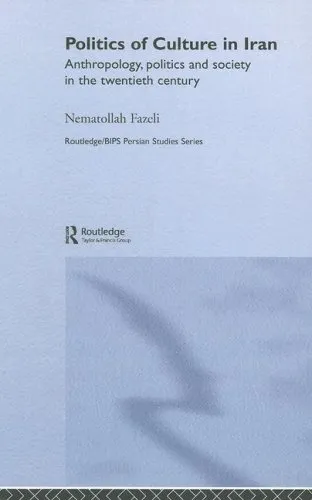
Book guide and evaluation
Politics of Culture in Iran: Anthropology, Politics and Society in the Twentieth Century (Routledge Bips Persian Studies)
Nematollah Fazeli
English
Unordered
Politics
4.0 / 5
0 reviews
2006
Published
273
pages
570
views
In the realm of sociocultural exploration, few works stand as comprehensively insightful as "Politics of Culture in Iran: Anthropology, Politics and Society in the Twentieth Century." Authored by Nematollah Fazeli, this compelling text offers a profound di
Before you read
What will you get from this book?
In the realm of sociocultural exploration, few works stand as comprehensively insightful as "Politics of Culture in Iran: Anthropology, Politics and Society in the Twentieth Century." Authored by Nematollah Fazeli, this compelling text offers a profound dive into the complex and multifaceted intersection of culture and politics within Iran throughout the pivotal twentieth century. With a critical eye, Fazeli dissects the intricate web of influences that have shaped Iranian society over decades, presenting a nuanced narrative that blends anthropology and political analysis.
Detailed Summary of the Book
"Politics of Culture in Iran" embarks on a scholarly journey through the sociopolitical landscape of Iran, decrypted through the lens of anthropology. The book underscores how cultural dynamics influence political transformations and vice versa. It explores the profound effects of modernization, Western influences, and the subsequent cultural reactions rooted in national values and identity. Each chapter intricately details key periods in Iranian history, from the Constitutional Revolution and the Pahlavi dynasty's reforms to the Islamic Revolution and beyond.
Fazeli meticulously charts the role of intellectuals, artists, and the state in crafting a cultural identity that oscillates between continuity and change. By examining educational reforms, media, art, and the shifting role of women, the book illuminates the tensions between tradition and modernity. Through a critical analysis enriched by rich ethnographic data, it becomes evident that Iranian culture is not a static entity but a dynamic force actively engaging with global currents.
Key Takeaways
- The interplay between culture and politics is essential to understanding Iran's historical and modern context.
- Modernization and Westernization efforts have been met with both enthusiasm and resistance by different sectors of society.
- Iran's cultural policy is deeply intertwined with its political agenda, reflecting broader global and regional influences.
- The cultural responses to state policies reveal a resilience and adaptability within Iranian society.
- Gender roles and the place of women in Iranian culture remain pivotal issues in cultural politics.
Famous Quotes from the Book
“Culture is not a passive reflection of political ideologies but an active agent in reshaping political narratives.”
“In Iran, the past dialogues with the present, crafting a future that is neither fully modern nor wholly traditional.”
“Understanding the cultural politics of Iran necessitates a journey into the heart of its intellectual and artistic expression.”
Why This Book Matters
"Politics of Culture in Iran" stands as a seminal work that bridges the often disparate worlds of anthropology, sociology, and political science. This book is not just an academic exploration; it is a crucial resource for policymakers, cultural analysts, and anyone seeking to understand Iran's complex cultural tapestry amidst rapid global change. Fazeli provides readers with a comprehensive framework to appreciate how cultural policies have consistently influenced Iran’s political decisions, societal movements, and overall historical trajectory.
In a world where cultural identities are continuously tested and reshaped under global pressures, this book highlights the critical importance of cultural integrity and self-awareness. It matters because it equips readers with the knowledge to engage critically with Iranian politics and society, offering deeper insights that go beyond stereotypes and generalized perceptions.
Ask this book
Your question is answered in the context of this title and author. Each answer uses 2 points.
Sign in to ask the book assistant.
Reader reviews
0 reviews, 4.0 average out of 5
No reviews yet
If you have read this book, help the next reader with your experience.
Write a review
Sign in to publish a review.
Reader questions and answers
Ask a focused question and learn from the community.
Sign in to ask or answer a question.
No questions yet
Be the first to ask a clear, useful question.
What to read next
Related references that continue this learning path.