Loading
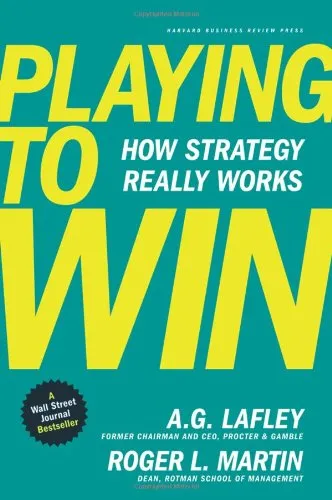
Cover of Playing to Win: How Strategy Really Works

Book guide and evaluation

Playing to Win: How Strategy Really Works

A.G. Lafley,Roger L. Martin

English Beginner Brand Management
4.7 / 5

3 reviews

2013

Published

272

pages

3341

views

Introduction to "Playing to Win: How Strategy Really Works" "Playing to Win: How Strategy Really Works" is a comprehensive guide to understanding and formulating effective business strategies, authored by two industry titans, A.G. Lafley, former CEO of Procter & Ga

Before you read

What will you get from this book?

Introduction to "Playing to Win: How Strategy Really Works"

"Playing to Win: How Strategy Really Works" is a comprehensive guide to understanding and formulating effective business strategies, authored by two industry titans, A.G. Lafley, former CEO of Procter & Gamble, and Roger L. Martin, a celebrated business thinker. This book explores the fundamental approach to strategic thinking that propelled Procter & Gamble to the forefront of the consumer goods industry.

The book is essentially a playbook for businesses seeking to climb the ranks of market leadership through a structured method of strategic planning. Lafley and Martin break down complex concepts into actionable insights that stakeholders at any level of an organization can comprehend and utilize. They present a lucid narrative that interweaves real-world corporate scenarios with strategic theory, thereby providing readers with practical knowledge grounded in proven effectiveness.

Detailed Summary of the Book

At the heart of "Playing to Win" is the assertion that strategy is as much about what you choose not to do as what you choose to do. The authors outline a simple yet robust framework that pivots on five critical choices:

  1. The Winning Aspiration: Defining what winning means for your organization.
  2. Where to Play: Identifying the precise market segments and regions where your business should compete.
  3. How to Win: Establishing how your organization can uniquely deliver value to customers in these selected segments.
  4. Core Capabilities: Recognizing the essential skills and abilities required to achieve success.
  5. Management Systems: Ensuring that your organization has robust systems in place to support and sustain the chosen strategy.

These choices form the backbone of the strategic framework that has been celebrated for its straightforward approach and profound impact. The authors further enrich the narrative by including anecdotes from P&G’s transformation under this strategic pattern, illustrating how deliberate and informed choices can lead to unprecedented success.

Key Takeaways

  • Strategy involves making deliberate choices to avoid spreading resources too thinly across pursuits.
  • Defining your winning aspiration is the starting block for all strategic decisions.
  • Implementation of strategy should be supported by aligning organizational capabilities and systems.
  • Clarity and focus in strategic planning enable better decision-making and resource allocation.

Famous Quotes from the Book

"To play to win, companies must confront the eternal choice between where they'll play and how they'll win." This quote embodies the core essence of the book's strategic stance, highlighting the crucial choices companies must make to achieve excellence.

"Strategy is choice. Strategy means saying no to certain things." Stressing the importance of focus, this quote succinctly conveys the book's message on the decisiveness needed in strategic planning.

Why This Book Matters

"Playing to Win" is not just another business strategy book; it is a transformative guide through which the authors share their deep-seated beliefs and experiences from having executed strategies that yield tangible results. The book matters because it addresses the frequent disconnect seen in many companies grappling with strategic paralysis or hyperactive direction shifts that lead to strategic entropy.

For executives, managers, and budding entrepreneurs, this book provides a roadmap to navigate the convoluted business landscape with clear, decisive strategic thought. Its relevance is perennial in nature due to its applicability across different industries, making it an invaluable addition to any professional’s library.

By focusing on what constitutes a viable strategy - the deliberate choices that define how businesses engage with competition and deliver value - "Playing to Win" empowers its readers to embrace strategy not as a static plan but a dynamic and ongoing set of decisions that sculpt long-term success.

Ask this book

Your question is answered in the context of this title and author. Each answer uses 2 points.

Sign in to ask the book assistant.

Your previous questions

ioi
Sorry your question is not related to my book.

Reader reviews

3 reviews, 4.7 average out of 5

luan13

2025/11/06

5 / 5

Playing to Win: How Strategy Really Works — Roger L. Martin & A. G. Lafley

Em Playing to Win, Roger L. Martin e A. G. Lafley (ex-CEO da Procter & Gamble) redefinem o conceito de estratégia empresarial de maneira pragmática e aplicável. Longe de tratar estratégia como um plano extenso ou um documento de intenções, os autores a posicionam como um sistema coerente de escolhas interdependentes que determinam onde e como uma organização decide competir para vencer.

O ponto central é a definição de estratégia como escolha. Para Martin, vencer requer foco: abrir mão de certas oportunidades para reforçar as que geram vantagem competitiva real. Essa visão se estrutura em um framework simples e poderoso de cinco perguntas fundamentais:
1. O que significa vencer?
2. Onde vamos competir?
3. Como vamos vencer?
4. Quais capacidades são necessárias para isso?
5. Quais sistemas de gestão darão suporte a essas escolhas?

Essas perguntas, aplicadas em sequência, formam a espinha dorsal de um processo estratégico disciplinado e prático — usado pela P&G para revitalizar marcas como Olay, Tide e Gillette.

Diferente de abordagens tradicionais (como Porter ou Mintzberg), Martin e Lafley tratam a estratégia menos como análise e mais como design de escolhas integradas. Eles defendem que o verdadeiro poder estratégico vem da coerência entre decisão e execução, e não de previsões detalhadas ou benchmarking infinito.

O livro também introduz a ferramenta “Choice Cascade”, que mostra como decisões estratégicas devem “cair” em níveis sucessivos da organização, garantindo alinhamento entre propósito, mercado e operação.

Pontos fortes
• Clareza e aplicabilidade imediata — especialmente útil para líderes, gestores de portfólio e profissionais de transformação digital.
• Equilíbrio entre teoria e exemplos reais da P&G, mostrando o impacto concreto das decisões estratégicas.
• Linguagem acessível sem perder profundidade conceitual.

Limitações

Alguns leitores podem sentir falta de uma discussão mais profunda sobre contextos de incerteza extrema ou inovação disruptiva. O framework é poderoso, mas funciona melhor em organizações já estruturadas, com processos de decisão maduros.

Conclusão

Playing to Win é uma leitura essencial para quem busca entender estratégia como prática, não como teoria. Ele transforma um conceito frequentemente nebuloso em um guia claro para decidir — e agir — com propósito competitivo.

“Estratégia é sobre escolhas. E escolher é, inevitavelmente, abrir mão.”
— Roger L. Martin
yahaya7

2025/12/07

4 / 5

Playing to Win: How Strategy Really Works — Roger L. Martin & A. G. Lafley

Em Playing to Win, Roger L. Martin e A. G. Lafley (ex-CEO da Procter & Gamble) redefinem o conceito de estratégia empresarial de maneira pragmática e aplicável. Longe de tratar estratégia como um plano extenso ou um documento de intenções, os autores a posicionam como um sistema coerente de escolhas interdependentes que determinam onde e como uma organização decide competir para vencer.

connor5

2025/12/08

5 / 5

Great book! Loved it.

Write a review

Sign in to publish a review.

Reader questions and answers

Ask a focused question and learn from the community.

Sign in to ask or answer a question.

No questions yet

Be the first to ask a clear, useful question.