

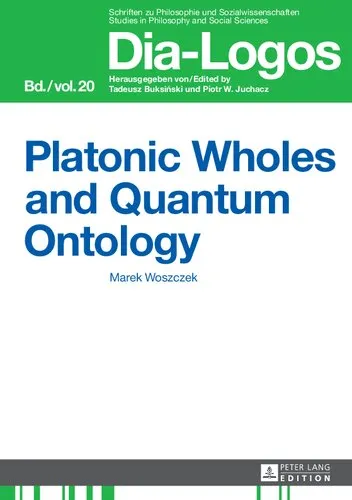
Book guide and evaluation
Platonic Wholes and Quantum Ontology
Marek Woszczek,Katarzyna Kretkowska (transl.)
English
Beginner
Art
4.4 / 5
0 reviews
2015
Published
292
pages
178
views
Welcome to the enlightening exploration that is Platonic Wholes and Quantum Ontology. This book serves as an intellectual bridge between classical metaphysical ideas and the counterintuitive realities of modern quantum physics. Written with precision and p
Before you read
What will you get from this book?
Welcome to the enlightening exploration that is Platonic Wholes and Quantum Ontology. This book serves as an intellectual bridge between classical metaphysical ideas and the counterintuitive realities of modern quantum physics. Written with precision and philosophical depth, this work dives into core questions about the nature of existence, the interconnectedness of reality, and how ancient Platonic doctrines resonate with contemporary quantum theories.
Detailed Summary
At its heart, Platonic Wholes and Quantum Ontology seeks to uncover the underlying structures of reality by engaging with two seemingly disparate perspectives: the metaphysical wholes of Platonic thought and the fragmented yet interconnected ontology of quantum physics. Plato, in his philosophy, introduced the concept of timeless and abstract forms, which underpin and give shape to the material world. Meanwhile, quantum mechanics, a relatively modern scientific paradigm, presents a world where particles are fundamentally interconnected, displaying behaviors such as non-locality, entanglement, and superposition.
This book begins by revisiting Plato’s conception of ontological wholeness and the role of forms as unifying principles. From there, it delves into key topics within quantum mechanics—such as wave-particle duality and quantum entanglement—that challenge classical materialism. By paralleling Platonic metaphysics with quantum insights, the text argues for a novel interpretation of reality: one that acknowledges the primacy of wholes over parts and the interdependent nature of existence.
The book is structured across several chapters, each methodically unraveling specific philosophical and scientific phenomena. Whether examining the epistemological implications of the uncertainty principle or drawing connections between the notion of beauty in Platonic aesthetics and symmetry within physics, this work offers a cohesive and interdisciplinary perspective. Ultimately, it champions the "re-enchantment" of the world—a view that embraces complexity, interconnectedness, and the transcendent.
Key Takeaways
- The universe can be understood as a dynamic interplay between the whole and its parts, with neither existing independently.
- Plato’s metaphysical doctrine of forms echoes the non-empirical nature of quantum entities such as wave functions.
- Quantum entanglement challenges the classical concept of separability, affirming the interconnectedness of all existence.
- Our modern understanding of reality could benefit from revisiting ancient philosophical frameworks.
- Philosophy and science are not opposing disciplines but complementary tools in our quest to comprehend reality.
Famous Quotes from the Book
"Reality is a mosaic of wholeness; each fragment a reflection of the ineffable unity that binds everything together."
"To truly understand the quantum world, we must first transcend the limitations of a materialist ontology."
"Plato’s forms are not relics of the past but a timeless guide to deciphering the organized chaos of contemporary science."
Why This Book Matters
Platonic Wholes and Quantum Ontology is not merely a work of philosophy or physics but an essential contribution to humanity’s enduring quest for meaning. In an age dominated by reductionism and hyper-specialization, the book advocates for a more holistic perspective that bridges ancient wisdom and modern science. This interdisciplinary approach empowers readers to question the foundations of their worldview and to embrace the mysterious, interconnected nature of reality.
Moreover, the book is relevant in addressing pressing questions about artificial intelligence, consciousness, and the ethics of technological progress. By emphasizing the primacy of wholes and the necessity of unity, it challenges fragmented thinking and urges us to adopt a broader, more harmonious perspective.
Whether you’re a philosopher, scientist, or seeker of truth, Platonic Wholes and Quantum Ontology offers you a profound opportunity to reevaluate the fundamental assumptions underlying our understanding of the universe. In doing so, it inspires not just intellectual engagement but a transformative way of seeing ourselves and the cosmos.
Ask this book
Your question is answered in the context of this title and author. Each answer uses 2 points.
Sign in to ask the book assistant.
Reader reviews
0 reviews, 4.4 average out of 5
No reviews yet
If you have read this book, help the next reader with your experience.
Write a review
Sign in to publish a review.
Reader questions and answers
Ask a focused question and learn from the community.
Sign in to ask or answer a question.
No questions yet
Be the first to ask a clear, useful question.
What to read next
Related references that continue this learning path.


Modern Computer Vision with PyTorch: A Practical Roadmap From Deep Learning Fundamentals to Advanced Applications and Generative AI, 2nd Edition
V Kishore Ayyadevara,Yeshwanth Reddy
2023
View book