

Book guide and evaluation
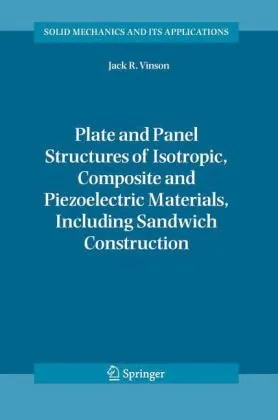
Plate and Panel Structures of Isotropic, Composite and Piezoelectric Materials, Including Sandwich Construction (Solid Mechanics and Its Applications)
Jack R. Vinson
English
Beginner
Engineering
4.5 / 5
0 reviews
2005
Published
423
pages
182
views
Introduction The field of solid mechanics continues to play a critical role in modern engineering and material science, offering essential insights into structural behavior and design optimization. My book, Plate and Panel Structures of Isotropic, Composite and Piezoelectr
Before you read
What will you get from this book?
Introduction
The field of solid mechanics continues to play a critical role in modern engineering and material science, offering essential insights into structural behavior and design optimization. My book, Plate and Panel Structures of Isotropic, Composite and Piezoelectric Materials, Including Sandwich Construction (Solid Mechanics and Its Applications), serves as a comprehensive resource for engineers, researchers, and students seeking to understand advanced plate and panel structures. By exploring isotropic, composite, and piezoelectric materials, as well as sandwich construction, the book provides a robust theoretical foundation while emphasizing practical application.
Detailed Summary
At its core, this book examines the structural behavior of plate and panel systems subjected to various loads, boundary conditions, and environmental factors. The text delves into the mechanics of isotropic materials, which are characterized by uniform properties in all directions, as well as composite materials that allow for improved strength-to-weight ratios and customizable mechanical properties. Special attention is given to piezoelectric materials, which couple mechanical and electrical responses, enabling their use in sensors, actuators, and smart systems.
A significant portion of the book is dedicated to sandwich constructions, where lightweight core materials are combined with stiff, strong face sheets to form structures with exceptional stiffness and strength-to-weight characteristics. The extensive discussion spans fundamental principles, design methodologies, numerical modeling techniques, and their real-world applications in aerospace, automotive, and civil engineering.
The chapters in this book are organized to progressively build the reader's understanding. Early sections outline the theoretical concepts of elasticity, plate theory, and panel mechanics. Later sections apply these theoretical models to specific material types and structural challenges. Advanced analysis techniques, including finite element methods and vibration analysis, are presented, empowering readers to solve complex engineering problems confidently.
Key Takeaways
- Develop a deep understanding of the mechanics of isotropic, composite, and piezoelectric materials.
- Learn the fundamentals of sandwich construction and its extensive application in lightweight structural design.
- Gain expertise in advanced analysis techniques such as finite element modeling and dynamic behavior analysis.
- Bridge the gap between theoretical principles and engineering practice with real-world examples and case studies.
- Explore the future potential of advanced materials and structural systems in innovative engineering applications.
Famous Quotes from the Book
"Engineering excellence stems from a profound understanding of materials, their mechanics, and their interactions within structural systems."
"The success of sandwich construction lies in its ability to maximize performance while minimizing weight, truly embodying the concept of optimized design."
Why This Book Matters
This book stands out as a crucial resource in the domain of structural mechanics, combining foundational theory with applied engineering practices. It caters to a diverse audience, from students beginning their journey in solid mechanics to seasoned engineers tackling complex design challenges. By addressing a wide spectrum of materials—including those with advanced functionalities like piezoelectricity—this text ensures readers remain at the forefront of material science and structural innovation.
The detailed exploration of sandwich constructions is particularly timely, given their growing prominence in sectors such as aerospace and automotive engineering, where lightweight yet strong structures are essential. Furthermore, the book’s integration of finite element modeling and advanced numerical techniques ensures that readers can translate theoretical knowledge into effective computational tools for real-world problem-solving.
In a rapidly advancing field, staying informed on the latest research and design methodologies is imperative. Plate and Panel Structures of Isotropic, Composite and Piezoelectric Materials provides its readers with the insights and tools necessary to pioneer innovative solutions in structural and material design.
Ask this book
Your question is answered in the context of this title and author. Each answer uses 2 points.
Sign in to ask the book assistant.
Reader reviews
0 reviews, 4.5 average out of 5
No reviews yet
If you have read this book, help the next reader with your experience.
Write a review
Sign in to publish a review.
Reader questions and answers
Ask a focused question and learn from the community.
Sign in to ask or answer a question.
No questions yet
Be the first to ask a clear, useful question.
What to read next
Related references that continue this learning path.


Modern Computer Vision with PyTorch: A Practical Roadmap From Deep Learning Fundamentals to Advanced Applications and Generative AI, 2nd Edition
V Kishore Ayyadevara,Yeshwanth Reddy
2023
View book