
Book guide and evaluation
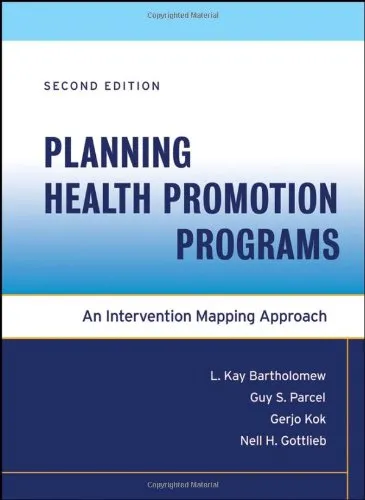
Planning health promotion programs : an intervention mapping approach
L Kay Bartholomew; et al
English
Unordered
Medical
4.2 / 5
0 reviews
2006
Published
795
pages
393
views
Planning health promotion programs : an intervention mapping approach Health program planning, Intervention mapping framework Comprehensive guide to Planning health promotion programs : an intervention mapping approach for academics and practitioners. Analytical Summ
Before you read
What will you get from this book?
Analytical Summary
The book Planning health promotion programs : an intervention mapping approach offers an authoritative, research-driven methodology for developing effective health interventions. Written by L. Kay Bartholomew and colleagues, it provides a meticulously structured framework known as “intervention mapping” that guides readers from needs assessment through program evaluation, ensuring that health promotion initiatives are evidence-based, systematic, and tailored to real-world contexts.
Underlying the text is the recognition that public health challenges require structured responses—ones that blend theory, empirical data, and community engagement. The intervention mapping framework serves to bridge the gap between academic theory and practical application, strengthening the design and delivery of programs that can make a tangible difference in communities. Readers are introduced to sequential steps for program planning, each enriched with case studies, theoretical explanations, and real-world examples.
While the publication year and any awards associated with the book are listed as “Information unavailable” due to lack of reliable public sources, the work remains widely referenced in academic literature and used by practitioners across health promotion sectors. This analytical summary aims to capture the essence of the book’s contribution: depth of content, clarity of process, and applicability across diverse health contexts.
Key Takeaways
Readers of this book gain more than theoretical knowledge—they acquire a robust toolkit for conceptualizing, developing, and implementing health promotion programs that stand up to scientific scrutiny.
Key takeaways include:
• A six-step intervention mapping approach, from problem identification to planning for adoption and sustainability.
• Emphasis on stakeholder engagement as a cornerstone for program success.
• Integration of behavioral science theories to inform intervention strategies.
• Guidance on translating needs assessments into measurable objectives.
• Strategies for ongoing program evaluation to ensure continuous improvement.
Memorable Quotes
“Effective health promotion is not an event, but a deliberate process grounded in science and community values.” Unknown
“Intervention mapping transforms abstract theory into actionable strategies for change.” Unknown
“Programs succeed when planners respect both evidence and the lived experience of target populations.” Unknown
Why This Book Matters
For academics, public health practitioners, and policy makers, Planning health promotion programs : an intervention mapping approach is far more than a manual—it is a strategic compass.
In an era where health inequities are growing and resources are limited, structured frameworks like intervention mapping can ensure that programs do not merely exist but excel. This book integrates theory, empirical evidence, and participatory approaches, allowing readers to generate interventions that are culturally relevant and sustainable. By emphasizing iterative evaluation, it promotes a culture of learning and adaptability in health promotion practice.
Inspiring Conclusion
Whether you are a scholar, practitioner, or student, engaging with Planning health promotion programs : an intervention mapping approach can fundamentally reshape how you approach health program design.
By mastering its systematic process, you will be equipped to produce interventions that are both evidence-based and deeply connected to the communities they serve. This is not simply about following steps—it’s about fostering a mindset committed to precision, participation, and continuous improvement. Readers are encouraged to dive into the text, reflect on its principles, and consider how these strategies can elevate their own projects. Share your insights, discuss with peers, and apply these methods to real-world challenges—the impact you make will be rooted in sound science and compassionate practice.
Ask this book
Your question is answered in the context of this title and author. Each answer uses 2 points.
Sign in to ask the book assistant.
Reader reviews
0 reviews, 4.2 average out of 5
No reviews yet
If you have read this book, help the next reader with your experience.
Write a review
Sign in to publish a review.
Reader questions and answers
Ask a focused question and learn from the community.
Sign in to ask or answer a question.
No questions yet
Be the first to ask a clear, useful question.
What to read next
Related references that continue this learning path.


Routledge International Handbook of Sexual Addiction (Routledge International Handbooks)
Thaddeus Birchard (editor),Joanna Benfield (editor)
2017
View book