IEEE Trial Use Standard for Application and Management of the Systems Engineering Process (IEEE Std 1220
Software Engineering Standards Committee of the IEEE Computer SociCODE: OS
1994
View book
Book guide and evaluation
Michael C. K. Khoo
0 reviews
Published
pages
views
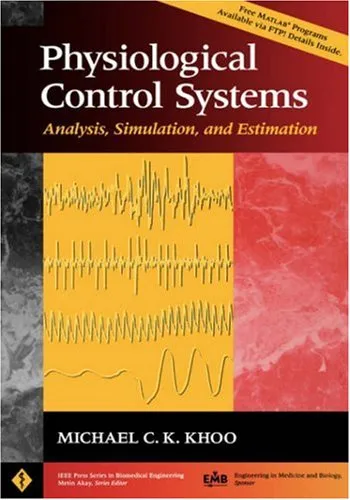
Introduction to Physiological Control Systems: Analysis, Simulation, and Estimation Welcome to an in-depth exploration of "Physiological Control Systems: Analysis, Simulation, and Estimation," a seminal work in the field of biomedical engineering. This book offers a compre
Before you read
Welcome to an in-depth exploration of "Physiological Control Systems: Analysis, Simulation, and Estimation," a seminal work in the field of biomedical engineering. This book offers a comprehensive approach to understanding how mathematical techniques can model and analyze physiological systems, which are inherently complex and nonlinear. Specifically crafted for students, researchers, and professionals in biomedical engineering, this book is a cornerstone for anyone looking to deepen their understanding of physiological systems using quantitative methods.
"Physiological Control Systems" delves into the mathematical modeling and analysis of various physiological systems, such as the cardiovascular and respiratory systems. The first section offers foundational knowledge, guiding readers through essential concepts like system dynamics, stability, and feedback control.
The book progresses to cover advanced topics, including estimation and system identification techniques, which are crucial for developing accurate physiological models. By leveraging examples and computational simulations, the author makes these complex ideas more approachable, fostering both theoretical understanding and practical skills.
Besides imparting knowledge on physiological modeling, the book uniquely integrates simulation and estimation into one cohesive framework. This enables readers to seamlessly translate theoretical insights into simulated models, providing a deeper comprehension of how physiological systems behave in real-world scenarios.
"Understanding the dynamics of physiological systems requires more than a mere glance at biological data; it requires a detailed, quantitative framework."
"Simulation provides a bridge between theoretical models and their real-world counterparts, allowing us to visualize and manipulate the unseen forces governing physiological behaviors."
"Physiological Control Systems" is pivotal for several reasons. Firstly, it empowers readers with the ability to utilize sophisticated mathematical tools to analyze and simulate physiological systems, a skill that is increasingly in demand within the healthcare and research fields. The integration of theory with practice ensures that readers are not only versed in the abstract concepts but are also equipped to apply these concepts in practical situations.
Secondly, the book fills an essential gap in biomedical education by offering a structured approach to control systems within a physiological context. This specificity helps readers gain targeted expertise that is directly applicable to challenges faced in biomedical engineering, such as designing adaptive feedback systems in medical devices.
Lastly, the author’s emphasis on using simulations provides an experiential learning approach that is crucial for translating complex models into actionable insights. This hands-on methodology is invaluable for fostering innovation and development in biomedical technologies.
Your question is answered in the context of this title and author. Each answer uses 2 points.
0 reviews, 4.3 average out of 5
Sign in to publish a review.
Ask a focused question and learn from the community.
Related references that continue this learning path.
Software Engineering Standards Committee of the IEEE Computer SociCODE: OS