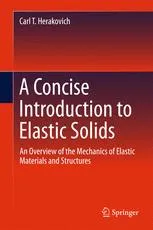
A Concise Introduction to Elastic Solids: An Overview of the Mechanics of Elastic Materials and Structures
Carl T. Herakovich (auth.)
2017
View book
Book guide and evaluation
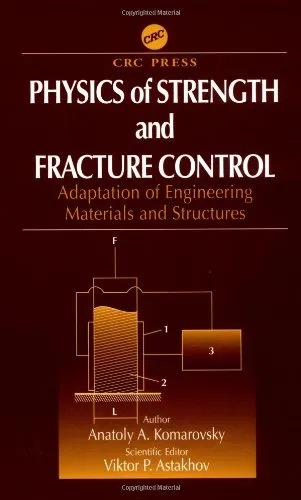
Anatoly A. Komarovsky,Viktor P. Astakhov
0 reviews
Published
pages
views
Introduction to "Physics of Strength and Fracture Control: Adaptation of Engineering Materials and Structures" "Physics of Strength and Fracture Control: Adaptation of Engineering Materials and Structures," authored by Anatoly A. Komarovsky and Viktor P. Astakh
Before you read
"Physics of Strength and Fracture Control: Adaptation of Engineering Materials and Structures," authored by Anatoly A. Komarovsky and Viktor P. Astakhov, delves deep into the core principles governing the mechanical behavior of materials. The book provides a unique and comprehensive perspective on understanding how materials adapt to external forces, resist damage, and fail under extreme conditions. By bridging the gap between theoretical principles and practical engineering applications, this work has become an invaluable resource for both students and professionals in the fields of materials science, mechanical engineering, and structural design.
The narrative systematically explores the fundamental physics underlying strength, deformation, and fracture mechanisms operating within materials. It builds on foundational concepts of stress, strain, and material properties, progressing to advanced topics like fracture mechanics, fatigue, wear, and real-world applications. Unlike purely theoretical works, this book emphasizes the synergy between physical understanding and practical adaptability, arming engineers with actionable insights to predict, control, and optimize material behavior under operational conditions.
Each chapter is carefully structured to provide clear explanations, supported by examples, mathematical analyses, and engineering case studies. Whether you're conducting failure analysis, designing robust structures, or researching novel materials, this book serves as both a roadmap and a reference manual. Let’s explore the detailed summary, key takeaways, memorable quotes, and the significance of this landmark book.
The book begins by introducing the basic principles of material strength and elaborates on fundamental concepts like stress, strain, elasticity, and plasticity. These are foundational to understanding material adaptability under varying loads and environmental conditions. The authors then transition into the physics of deformation processes, shedding light on microscopic and macroscopic mechanisms responsible for material responses.
Moving further, the text delves into fracture mechanics, explaining critical stress intensities, crack propagation, and modes of fracture. The authors explore failure modes such as ductile fracture, brittle fracture, fatigue, and wear, offering insights on how to design against them. A special focus is devoted to fatigue resistance and crack growth phenomena, which are crucial for industries like aerospace, automotive, and civil engineering.
The book doesn’t merely stop at analyzing material failures but extends to strategies for enhancing material performance under operational conditions. Topics such as surface engineering, residual stress adaptation, and structural optimization are examined in depth. Each concept is contextualized through real-world scenarios, helping readers appreciate the practical implications of material science and mechanics.
"Understanding the physics of strength and fracture is not merely an academic exercise; it is the cornerstone of engineering, transforming abstract design concepts into resilient, real-world structures."
"Materials adapt to their environments in surprising ways; to master engineering is to master the art of anticipating these adaptations."
"The strength of a material lies not only in its composition but in its ability to resist and recover from failure."
This book is not just another textbook on materials science—it’s a definitive guide that bridges the theoretical and the practical. Engineers, researchers, and students alike will find its content deeply relevant to contemporary challenges in design, manufacturing, and material innovation.
In a world where industries rely on high-performance materials and fail-safe designs, understanding the principles of strength and fracture control is indispensable. This book equips readers with the tools to proactively engineer solutions that are not only functional but also durable and adaptable.
Moreover, the insights it provides extend beyond engineering—it offers a philosophy of adaptation, resilience, and optimization that echoes across various technical fields. With its rich blend of theory, practice, and application, the book remains a cornerstone reference for those engaged in pushing the boundaries of material sciences and structural engineering.
Your question is answered in the context of this title and author. Each answer uses 2 points.
0 reviews, 4.3 average out of 5
Sign in to publish a review.
Ask a focused question and learn from the community.
Related references that continue this learning path.
Carl T. Herakovich (auth.)
Helmut Kronmüller,Stuart Parkin