
Book guide and evaluation
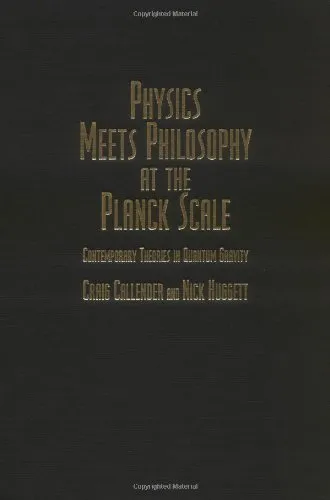
Physics Meets Philosophy at the Planck Scale: Contemporary Theories in Quantum Gravity
Craig Callender,Nick Huggett
English
Beginner
Physics
4.6 / 5
0 reviews
2001
Published
376
pages
358
views
Introduction to "Physics Meets Philosophy at the Planck Scale: Contemporary Theories in Quantum Gravity" "Physics Meets Philosophy at the Planck Scale: Contemporary Theories in Quantum Gravity" is a groundbreaking interdisciplinary exploration of one of the most profound fro
Before you read
What will you get from this book?
Introduction to "Physics Meets Philosophy at the Planck Scale: Contemporary Theories in Quantum Gravity"
"Physics Meets Philosophy at the Planck Scale: Contemporary Theories in Quantum Gravity" is a groundbreaking interdisciplinary exploration of one of the most profound frontiers in modern science. Written by Craig Callender and Nick Huggett, the book bridges the gap between theoretical physics and philosophy to examine quantum gravity—the theory that seeks to unify quantum mechanics and general relativity. This book lives at the nexus where physics and philosophy meet, offering unique insights that challenge conventional paradigms, while providing new conceptual tools for approaching the nature of reality at the Planck scale.
The Planck scale represents the smallest scales in the universe, where our classical understanding of space and time begins to break down. At this limit, quantum effects dominate, making it an essential testing ground for unifying general relativity, which governs large-scale phenomena, and quantum mechanics, which governs the microscopic world. This book not only examines current advances in quantum gravity but also explores the deep conceptual issues that arise when physicists and philosophers confront the extraordinary implications of these cutting-edge theories. It is a multidisciplinary journey, aimed not just at experts but at any curious mind eager to grapple with the mysteries of existence.
Detailed Summary
The book is divided into essays contributed by leading physicists and philosophers. These essays build a comprehensive picture of quantum gravity—an effort to develop a theory that unites Einstein's general relativity with quantum mechanics. The works delve into various approaches to quantum gravity, from string theory to loop quantum gravity and beyond. Each approach opens new doors to understanding the underlying fabric of the universe, with a particular emphasis on philosophical implications.
The contributors outline the failures and successes of competing models, emphasizing not only their technical assumptions but also their philosophical repercussions. For instance, the collapse of the Newtonian world of determinism gives rise to discussions about the nature of causality, space-time, and even the concept of time itself. The authors also explore how quantum gravity could radically reshape our conception of reality, challenging even the firmest metaphysical assumptions.
Readers are introduced to key debates, such as the viability of background independence as a feature of quantum gravity and whether space-time is fundamentally discrete or continuous. Beyond strictly scientific discussions, the contributors probe philosophical issues—like what the study of quantum gravity means for our understanding of human observation and our place in the universe.
Key Takeaways
- Quantum gravity seeks to unify the two pillars of modern physics: quantum mechanics and general relativity.
- The nature of space and time may be profoundly different at the Planck scale than our classical intuition suggests.
- Philosophical analysis is as important as mathematical rigor when tackling questions about the fundamental structure of reality.
- Debates about causality, determinism, and the ontology of space-time play a central role in cutting-edge physics.
- Theories like loop quantum gravity and string theory challenge our classical assumptions about continuity, discreteness, and the dimensionality of space-time.
Famous Quotes from the Book
"At the Planck scale, the very notions of space and time themselves begin to dissolve, leaving us with profound questions about the fabric of reality."
"The choice of how we approach quantum gravity is not merely a scientific one but a philosophical one, defining what we mean by 'the world' itself."
"Physics and philosophy are not separate enterprises when we confront the limits of our understanding of the universe."
Why This Book Matters
"Physics Meets Philosophy at the Planck Scale" is not merely a book about theoretical physics; it is a manifesto calling for interdisciplinary collaboration to address humanity's deepest intellectual mysteries. By uniting the rigorous challenges of physics with the speculative horizon of philosophy, the book provides a unique platform for understanding the Planck scale—a realm where our current physical theories break down.
Its relevance lies in the fact that understanding quantum gravity is key to building a complete framework of physical laws. The work's exploration of broad philosophical and foundational issues ensures that its influence stretches beyond the scientific community to anyone interested in understanding the universe in its most fundamental aspects.
By fostering a dialogue between disciplines, this book not only encourages new insights in quantum gravity but also serves as a model for how science and philosophy can come together to illuminate questions of profound significance. It is a must-read for anyone passionate about physics, metaphysics, and the search for truth.
Ask this book
Your question is answered in the context of this title and author. Each answer uses 2 points.
Sign in to ask the book assistant.
Reader reviews
0 reviews, 4.6 average out of 5
No reviews yet
If you have read this book, help the next reader with your experience.
Write a review
Sign in to publish a review.
Reader questions and answers
Ask a focused question and learn from the community.
Sign in to ask or answer a question.
No questions yet
Be the first to ask a clear, useful question.
What to read next
Related references that continue this learning path.

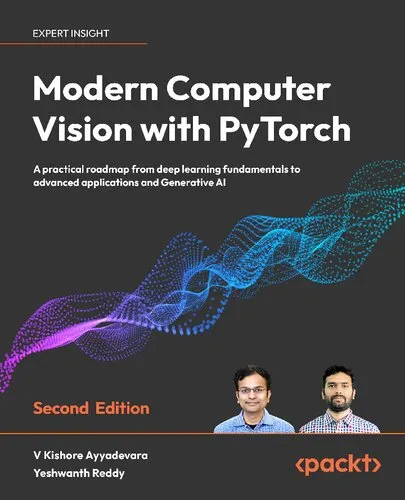
Modern Computer Vision with PyTorch: A Practical Roadmap From Deep Learning Fundamentals to Advanced Applications and Generative AI, 2nd Edition
V Kishore Ayyadevara,Yeshwanth Reddy
2023
View book