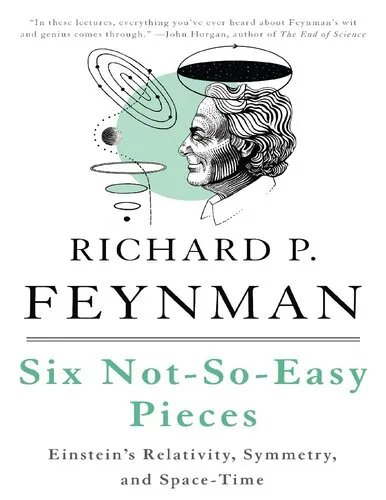
Six Not-So-Easy Pieces: Einstein’s Relativity, Symmetry, and Space-Time
Richard P. Feynman &Robert B. Leighton &Matthew Sands
2011
View book
Book guide and evaluation
Jakob Schwichtenberg (auth.)
0 reviews
Published
pages
views
Introduction to Physics from Symmetry Welcome to Physics from Symmetry, a book that bridges abstract mathematical ideas with the physical reality of our universe. If you’ve ever wondered how the profound simplicity of symmetry leads to some of the most fundamental equations in
Before you read
Welcome to Physics from Symmetry, a book that bridges abstract mathematical ideas with the physical reality of our universe. If you’ve ever wondered how the profound simplicity of symmetry leads to some of the most fundamental equations in physics, this book serves as a comprehensive, intuitive, and accessible guide.
The goal of this book is simple yet ambitious: to demystify the key physical theories—Quantum Mechanics, Classical Mechanics, and Relativity—through symmetry principles. Regardless of whether you are a student stepping into the world of theoretical physics or a professional seeking a fresh perspective, this text will offer clarity and insight into the deep connections between abstract mathematics and physical reality.
The book is structured to be both approachable and in-depth, making it suitable for readers with a basic understanding of physics and mathematics. Starting with the very concept of symmetry, the book builds a framework for understanding how symmetry principles serve as the cornerstone for nearly every major theoretical breakthrough in physics.
In the early chapters, we discuss fundamental mathematics such as group theory—a branch of algebra that underpins symmetries. From the rotations of a cube to the invariance of physical laws under transformations, these mathematical tools are presented in a way that balances rigor with simplicity.
Subsequent chapters delve into physics topics step by step. Classical mechanics, for example, is derived using basic symmetry arguments, such as time translation symmetry leading to conservation of energy. Moving to relativistic physics, the symmetry properties of spacetime are meticulously explored, showing how Einstein’s revolutionary equations arise naturally from these properties.
Quantum mechanics is perhaps the field where symmetry finds its most profound manifestation. Here, the focus is on Lie groups and Lie algebras, which describe continuous symmetries. These mathematical structures lay the foundation for understanding wave functions, operators, and spin—a framework essential for comprehending phenomena at microscopic scales.
To ensure a practical grasp of the material, numerous worked-out examples and exercises are peppered throughout the text. These hands-on elements allow readers to not just follow along passively but also to actively engage with the principles underpinning modern physics. Moreover, the book avoids overwhelming readers with excessive abstraction, ensuring a balance between theory and real-world applications.
“Symmetry is not just an aesthetic principle; it is the very language of physics.”
“The most complex phenomena in the universe can often be understood through the simplest patterns of symmetry.”
Physics is often perceived as a complex web of equations, disconnected from everyday intuition. Physics from Symmetry challenges this misconception by showing that, at its core, physics is about recognizing and utilizing patterns in nature. The book emphasizes that symmetry is a universal concept, connecting mathematical forms with physical phenomena.
This book matters because symmetry principles continue to drive frontier research in physics. Whether it’s the search for new particles in experiments like those at CERN or the quest for a unified theory, symmetry remains central. By understanding the foundational role of symmetry, readers will appreciate not only existing physical theories but also the direction of future discoveries.
More than just another textbook, Physics from Symmetry is a call to see physics as both an art and a science—an endeavor where beauty and utility converge.
In a field where many struggle to connect abstract mathematical formalisms with physical intuition, this book serves as a bridge, empowering its readers to approach physics with confidence, creativity, and wonder.
Your question is answered in the context of this title and author. Each answer uses 2 points.
0 reviews, 4.5 average out of 5
Sign in to publish a review.
Ask a focused question and learn from the community.
Related references that continue this learning path.
Richard P. Feynman &Robert B. Leighton &Matthew Sands
Gene Mosca,Todd Ruskell