

Book guide and evaluation
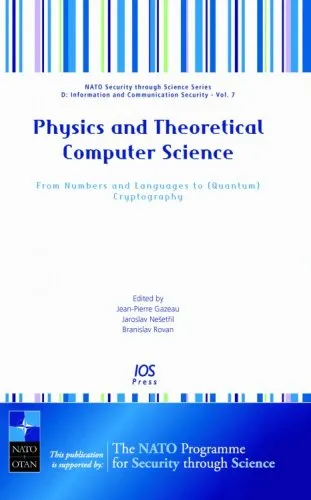
Physics and Theoretical Computer Science: From Numbers and Languages to (Quantum) Cryptography - Volume 7 NATO Security through Science Series: Information ... - Information and Communication Security)
Jean-Pierre Gazeau,Jaroslav Nesetril,Branislav Rovan
English
Beginner
Software Engineering
4.5 / 5
0 reviews
2007
Published
349
pages
190
views
Introduction to "Physics and Theoretical Computer Science: From Numbers and Languages to (Quantum) Cryptography" The ever-expanding fields of physics and theoretical computer science hold the potential to redefine human understanding of the universe and computation
Before you read
What will you get from this book?
Introduction to "Physics and Theoretical Computer Science: From Numbers and Languages to (Quantum) Cryptography"
The ever-expanding fields of physics and theoretical computer science hold the potential to redefine human understanding of the universe and computation. This book, "Physics and Theoretical Computer Science: From Numbers and Languages to (Quantum) Cryptography," is Volume 7 in the prestigious NATO Security through Science Series: Information and Communication Security. It bridges the disciplines of physics, mathematics, and computer science to explore wide-ranging topics like computation theory, cryptography, quantum computing, and information security. Authored by experts Jean-Pierre Gazeau, Jaroslav Nesetril, and Branislav Rovan, this collection is both a profound insight into complex ideas and a call to harness interdisciplinary research to solve global challenges.
By addressing topics like fundamental number theory, the relationship between languages and complex systems, and the rise of quantum cryptography, the book provides a platform for collaboration between physicists and computer scientists. Its significance lies not only in its technical depth but also in its relevance to modern-day issues such as data security and cryptographic advancements. Whether you are an academic, a student, or a professional in the field, this book offers a wealth of knowledge that is both rigorous and forward-thinking.
Detailed Summary of the Book
This book delves into the intricate intersection of physics and theoretical computer science, a domain where abstract mathematical concepts shape the physical world and computational methodologies revolutionize problem-solving. The authors skilfully weave a narrative that covers a broad spectrum of topics:
- Exploration of the fundamental properties of numbers and their application in physics and computing.
- A study of formal languages and their relevance in modeling both physical and computational systems.
- Introduction to quantum cryptography as the next frontier in securing digital communications.
- Discussions on combinatorial mathematics as a bridge between theoretical frameworks and practical computation.
Through meticulously curated chapters, readers are introduced to how physics and computation intertwine in applications ranging from secure communications to understanding computational limitations.
Key Takeaways
Whether you are exploring the basics of these disciplines or diving deep into their advanced interrelations, this book provides several key insights:
- Physics and computer science, while distinct, share an intrinsic relationship through mathematics, allowing for breakthroughs in both fields.
- Quantum computing and cryptography are redefining traditional approaches to data security and information integrity.
- Theoretical mathematics forms the backbone of both physics and computer science, underpinning everything from algorithms to secure communication protocols.
- Interdisciplinary approaches are critical to solving contemporary issues in computation and data security.
These takeaways illuminate the book's importance as an intellectual cornerstone for researchers in both fields and a source of real-world impact.
Famous Quotes from the Book
"The boundary between physics and theoretical computer science is not a limitation but a bridge—an invitation to explore untapped potentials."
"Cryptography, at its core, is the science of secrets. Its future lies in the quantum domain, where computation meets the probabilistic nature of the universe."
"Mathematics is the language of both computation and nature, making it the true unifying force in modern science."
Why This Book Matters
The relevance of this book transcends academic disciplines and professional boundaries. In an era dominated by digital transformation, securing information and advancing computation have become global imperatives. This book stands as a guiding resource for addressing these challenges through interdisciplinary collaboration. Here’s why it matters:
- It provides a unified framework for understanding how physics and computer science intersect, offering new perspectives for problem-solving.
- Quantum technologies discussed in the book are on the brink of transforming fields like cryptography, making this text highly timely and relevant.
- The exploration of mathematical constructs and their physical and computational implications inspires innovation across industries.
- By addressing real-world issues like secure communications, the book serves as a bridge between theoretical exploration and practical application.
Ultimately, this book exemplifies the power of interdisciplinary research in pushing the boundaries of what is possible in science and technology.
Ask this book
Your question is answered in the context of this title and author. Each answer uses 2 points.
Sign in to ask the book assistant.
Reader reviews
0 reviews, 4.5 average out of 5
No reviews yet
If you have read this book, help the next reader with your experience.
Write a review
Sign in to publish a review.
Reader questions and answers
Ask a focused question and learn from the community.
Sign in to ask or answer a question.
No questions yet
Be the first to ask a clear, useful question.
What to read next
Related references that continue this learning path.


Modern Computer Vision with PyTorch: A Practical Roadmap From Deep Learning Fundamentals to Advanced Applications and Generative AI, 2nd Edition
V Kishore Ayyadevara,Yeshwanth Reddy
2023
View book