

Book guide and evaluation
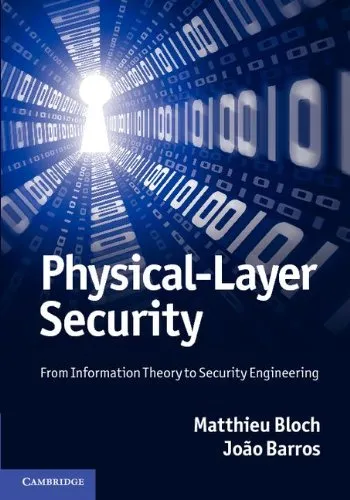
Physical-Layer Security: From Information Theory to Security Engineering
Matthieu Bloch,João Barros
English
Beginner
Engineering
4.8 / 5
0 reviews
2011
Published
345
pages
324
views
Introduction to "Physical-Layer Security: From Information Theory to Security Engineering" "Physical-Layer Security: From Information Theory to Security Engineering" is a thought-provoking and groundbreaking book that bridges the gap between the theory of secure communicat
Before you read
What will you get from this book?
Introduction to "Physical-Layer Security: From Information Theory to Security Engineering"
"Physical-Layer Security: From Information Theory to Security Engineering" is a thought-provoking and groundbreaking book that bridges the gap between the theory of secure communication and its practical implementation. Authored by Matthieu Bloch and João Barros, this book takes readers on a comprehensive journey through the foundations, advancements, and applications of physical-layer security — a paradigm designed to secure communication at the most fundamental measurable layer of network architecture.
As the internet-of-things (IoT), 5G networks, and other advanced communication systems continue to expand, the importance of security is more crucial than ever. Traditional cryptographic techniques face increasing challenges due to evolving computational power, quantum computing threats, and resource-constrained devices. This book offers a unique perspective by showcasing physical-layer security as a complementary approach that harnesses the inherent properties of communication media for safeguarding data.
Whether you are an academic researcher, systems engineer, or industry professional, this book is an invaluable resource for understanding the theoretical underpinnings of physical-layer security and how to engineer these principles into real-world systems.
Summary of the Book
The book begins with an introduction to the history and relevance of secure communication, establishing the challenges posed by modern technology and adversarial threats. It emphasizes why enhancing security at the physical layer can strengthen the current cybersecurity landscape.
Subsequent chapters delve deeper into the core principles of information-theoretic security, Shannon's secrecy capacity, and the role of channel properties such as noise and fading in securing communication. The authors balance rigorous mathematical treatments with intuitive explanations, enabling readers to grasp complex ideas step by step.
The book also connects theory to practice by exploring various engineering techniques for physical-layer security, including MIMO systems, cooperative jamming, and secret key generation. Case studies and practical examples across wireless, optical, and networked systems highlight the applicability and advantages of these methodologies.
Aspiring to provide a 360-degree approach, the book culminates with discussions on implementation hurdles, real-world limitations, and promising future directions for integrating physical-layer security within existing infrastructures.
Key Takeaways
- Physical-layer security leverages the intrinsic characteristics of communication channels to achieve secure information transmission.
- Unlike traditional cryptography, this approach does not rely on computational complexity but exploits principles of information theory.
- The mathematical rigor of this book is balanced with practical insights, making it accessible to both theoreticians and engineers.
- Techniques such as Gaussian wiretap coding, cooperative jamming, and artificial noise are examined in detail for their applicability.
- This book demonstrates how physical-layer security can coexist with and enhance traditional cryptographic methods.
Famous Quotes from the Book
"Security begins at the physical level, where the inherent features of communication channels become tools rather than obstacles."
"Rather than engage in an arms race of computational resources, physical-layer security offers a paradigm shift, enabling security through fundamental limits."
"The future of communication security is not only about securing data but also fully harnessing the physics of how data is transmitted."
Why This Book Matters
The significance of this book lies in its revolutionary approach to security. As the digital world becomes interconnected, adversarial threats are growing in sophistication. Traditional methods of security, which often depend on the computational infeasibility of certain problems, may become obsolete with the advent of technologies like quantum computing. Physical-layer security offers a scalable and sustainable alternative by directly embedding security within the communication process itself.
By providing both theoretical foundations and practical examples, this book equips the reader with the tools to understand and implement security solutions that take advantage of the physical properties of communication channels. It challenges conventional thinking and presents a new way forward in security research and practice. This text has already shaped academic research and engineering design and will continue to inspire advancements across telecommunications and cybersecurity fields.
"Physical-Layer Security: From Information Theory to Security Engineering" is more than just a book; it is a guide to the next frontier in secure communications. For anyone who wishes to stay ahead in a world increasingly reliant on secure networks, this is a must-read.
Ask this book
Your question is answered in the context of this title and author. Each answer uses 2 points.
Sign in to ask the book assistant.
Reader reviews
0 reviews, 4.8 average out of 5
No reviews yet
If you have read this book, help the next reader with your experience.
Write a review
Sign in to publish a review.
Reader questions and answers
Ask a focused question and learn from the community.
Sign in to ask or answer a question.
No questions yet
Be the first to ask a clear, useful question.
What to read next
Related references that continue this learning path.


Modern Computer Vision with PyTorch: A Practical Roadmap From Deep Learning Fundamentals to Advanced Applications and Generative AI, 2nd Edition
V Kishore Ayyadevara,Yeshwanth Reddy
2023
View book