Early Evolution of the Universe and its Present Structure
J. H. Oort (auth.),G. O. Abell,G. Chincarini (eds.)
1983
View book
Book guide and evaluation
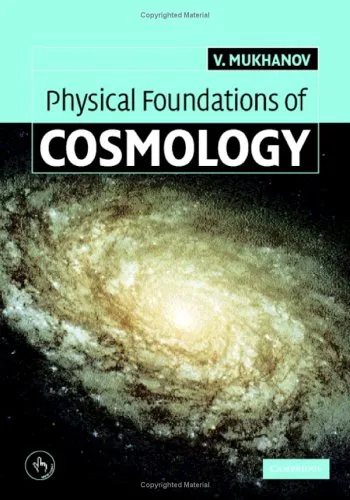
Viatcheslav Mukhanov
0 reviews
Published
pages
views
Introduction to 'Physical Foundations of Cosmology' Welcome to an exploration of the intricate universe as delineated in 'Physical Foundations of Cosmology'. This book presents a thorough examination of the principles underlying our understanding of the cosmos, providing a
Before you read
Welcome to an exploration of the intricate universe as delineated in 'Physical Foundations of Cosmology'. This book presents a thorough examination of the principles underlying our understanding of the cosmos, providing a detailed yet accessible introduction to the complex subject of cosmology. Whether you're an academic, a student, or simply an enthusiast, this book promises to enhance your comprehension of the universe's fundamental nature.
The book begins with a comprehensive introduction to the standard cosmological model and gradually unravels the mysteries of the universe through sophisticated theoretical frameworks and empirical data. It delves into the Big Bang theory, the cosmic microwave background radiation, and the formation of large-scale structures. Furthermore, it discusses the inflationary universe scenario, shedding light on the initial conditions and the exponential expansion that set the stage for the universe as we know it today. Throughout these discussions, the book balances deep theoretical insights with empirical findings, bridging the gap between complex mathematics and observable phenomena.
Subsequent chapters emphasize the physical processes driving the universe's evolution, integrating advanced topics such as quantum field theory in curved spacetime and gravitational wave background. The book also explores dark matter and dark energy, presenting these enigmatic elements as pivotal pieces of the cosmic puzzle. The discussion is further enriched by examining cosmological perturbations, which provide insights into galaxy formation and distribution.
"In the grand theater of the cosmos, the laws of physics serve as the script that comprehends the narratives of creation, evolution, and destiny of our universe."
"Understanding the early universe is akin to holding a piece of cosmic eternity, revealing the profound simplicity underlying the apparent complexity of existence."
'Physical Foundations of Cosmology' stands as a seminal text for its ability to lucidly present the necessities of cosmological science, making it indispensable for scholars and practitioners in the field. The book skillfully navigates through foundational theories and uncharted territories, igniting curiosity and fostering a deeper appreciation for the universe's grand design. By merging theoretical constructs with observational data, it ensures a holistic understanding of cosmology that is both in-depth and comprehensive.
The knowledge encapsulated in this book is vital not just for advancing cosmological research, but also for inspiring a new generation of thinkers and innovators who will continue to unravel the universe's timeless secrets. Its clarity of expression and depth of insight make it a must-read for anyone eager to comprehend the physical underpinnings of our cosmos.
Your question is answered in the context of this title and author. Each answer uses 2 points.
0 reviews, 4.7 average out of 5
Sign in to publish a review.
Ask a focused question and learn from the community.
Related references that continue this learning path.
J. H. Oort (auth.),G. O. Abell,G. Chincarini (eds.)
Professor Dr. Georgios Contopoulos,Professor Dr. Dimitrios Kotsakis (auth.)