THERMODYNAMICS: AN ENGINEERING APPROACH, NINTH EDITION
Çengel,Yunus A. Boles,Michael A. Kanoğlu,Mehmet
2019
View book
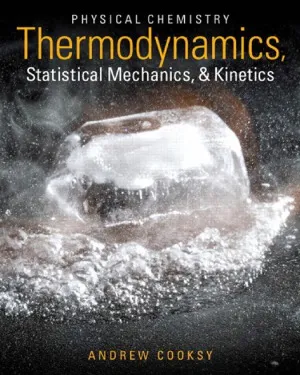
Book guide and evaluation
Andrew Cooksy
0 reviews
Published
pages
views
Welcome to the world of physical chemistry. In this book, "Physical Chemistry: Thermodynamics, Statistical Mechanics, and Kinetics," we journey through the fundamental concepts that lie at the core of how matter behaves at molecular and atomic levels. This text aims to buil
Before you read
Welcome to the world of physical chemistry. In this book, "Physical Chemistry: Thermodynamics, Statistical Mechanics, and Kinetics," we journey through the fundamental concepts that lie at the core of how matter behaves at molecular and atomic levels. This text aims to build a strong foundational understanding that bridges theoretical principles with practical applications, serving both students and professionals in the field.
The book is structured to guide readers through the three pillars of physical chemistry: thermodynamics, statistical mechanics, and kinetics. Each section is meticulously crafted to provide a rich narrative that connects abstract ideas with tangible examples.
In the thermodynamics section, we delve into the principles governing energy transformations and the laws that describe how systems evolve towards equilibrium. Students are introduced to concepts like enthalpy, entropy, Gibbs free energy, and the fundamental equations that express these ideas. Equally important is the exploration of real-world applications—how these principles influence everything from chemical reactions to industrial processes.
Statistical mechanics provides the second major framework by explaining the link between microscopic properties of atoms and molecules and macroscopic observables. Here, we uncover the probabilistic nature of molecular behavior and explore how statistical methods can predict physical properties of gases, liquids, and solids. The aim is to demystify complex systems through a clearer understanding of their statistical underpinnings.
The kinetics portion of the book reveals the principles that determine the speed of chemical reactions. Readers will learn about rate laws, reaction mechanisms, and the influence of catalysts. Experiencing kinetics through this lens not only highlights the dynamic aspects of chemical reactions but also opens pathways to manipulating these processes in technological and biological contexts.
"In thermodynamics, we find the answers to how energy steers the dance of the molecules."
"While atoms obey the rules, it is the collective disorder that brings about order."
Understanding physical chemistry is crucial for anyone seeking to unravel the mysteries of chemical processes. This book matters because it not only offers clarity and depth for learners but also inspires curiosity and innovation. In an era where the comprehension of molecular structure and behavior is paramount to advancements in technology, medicine, and environmental science, this text serves as an essential resource.
"Physical Chemistry: Thermodynamics, Statistical Mechanics, and Kinetics" seeks to ignite a passion for discovery and empower readers with the tools necessary to contribute meaningfully to scientific progress. Whether you are a student beginning your journey, an educator, or a seasoned professional, this book offers valuable insights that enhance your understanding and capability.
Your question is answered in the context of this title and author. Each answer uses 2 points.
0 reviews, 4.6 average out of 5
Sign in to publish a review.
Ask a focused question and learn from the community.
Related references that continue this learning path.
Çengel,Yunus A. Boles,Michael A. Kanoğlu,Mehmet
Jeremy Dunning-Davies
Vera, Juan H.;Wilczek-Vera, Grazyna