

The Big Questions: A Short Introduction to Philosophy
Robert C. Solomon,Kathleen M. Higgins
2013
View book
Book guide and evaluation
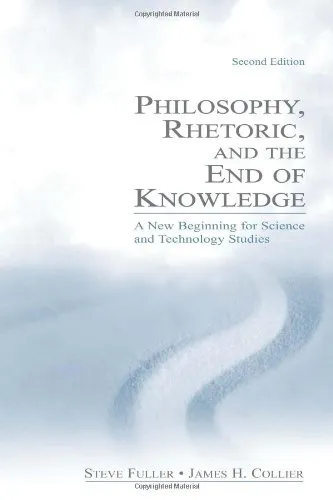
Steve Fuller,James H. Collier
0 reviews
Published
pages
views
Introduction to "Philosophy, Rhetoric, and the End of Knowledge: A New Beginning for..." Written by Steve Fuller and James H. Collier, "Philosophy, Rhetoric, and the End of Knowledge: A New Beginning for..." challenges the traditional foundations of knowledge production
Before you read
Written by Steve Fuller and James H. Collier, "Philosophy, Rhetoric, and the End of Knowledge: A New Beginning for..." challenges the traditional foundations of knowledge production by introducing a transformative dialogue between philosophy and rhetoric. This seminal work pushes the boundaries of how society understands knowledge in the modern era, critiquing established epistemic norms while offering a new perspective on the role of communication, persuasion, and argumentation in shaping truth and reality.
The book was born out of a need to address pressing questions about the function of philosophy in a time when scientific knowledge dominates intellectual discourse. Fuller and Collier traverse historical developments, intellectual controversies, and cross-disciplinary debates to create a comprehensive framework that merges theory with practicality. By doing so, they propose an alternative lens through which knowledge production can be understood—not as an objective, immutable entity but as a construct shaped by rhetoric and deeply tied to social contexts.
The book is divided into distinct sections, each building upon the previous to create a cohesive argument. At its core, it critiques the long-standing separation between philosophy as the pursuit of absolute truths and rhetoric as the art of persuasion. Fuller and Collier assert that this division is artificial and has hindered our understanding of knowledge creation.
The authors dive into the history of philosophy and science, examining the works of key figures such as Aristotle, Plato, and the sophists, while also considering modern intellectual movements like postmodernism and constructivism. They argue that science, often viewed as the ultimate arbiter of objective truth, is itself reliant on rhetorical strategies to sustain its authority and legitimacy.
Further, the book explores the impact of institutions, political forces, and culture in shaping knowledge. It questions whether true objectivity is possible—or even desirable—in a world where knowledge operates as a tool for negotiation, power dynamics, and societal cohesion. The authors challenge readers to reconsider what it means to "know" something and propose a "new beginning" for how philosophy and rhetoric can work together to spark meaningful conversations about truth, ethics, and progress.
"Science does not so much explain the world as it explains away rival accounts."
"Knowledge is never free of the social conditions under which it is produced."
"The rhetoric of science is not a distraction from its truth but the medium through which its truths become socially actionable."
This book is a pioneering contribution to the philosophy of knowledge, offering an alternative framework that resonates deeply with the intellectual and political challenges of the 21st century. It matters because it dares to question the sacred cows of objectivity, challenging assumptions about the neutrality of science and reasoning. By doing so, "Philosophy, Rhetoric, and the End of Knowledge" invites readers to adopt a more critical and reflective stance toward knowledge production in an increasingly complex world.
Moreover, this work has significant implications for a variety of fields, from science and technology studies to communication, education, and public policy. It emphasizes the importance of cross-disciplinary approaches and enriches our understanding of how ideas shape and are shaped by human interaction and institutions. Fuller and Collier’s bold vision for the future of knowledge forces both scholars and laypeople alike to question what it means to understand the world—and perhaps to embrace the uncertainty and flexibility that true intellectual engagement requires.
Your question is answered in the context of this title and author. Each answer uses 2 points.
0 reviews, 4.0 average out of 5
Sign in to publish a review.
Ask a focused question and learn from the community.
Related references that continue this learning path.
Robert C. Solomon,Kathleen M. Higgins


Robert Paul Wolff
Philip J. Davis,Reuben Hersh,Elena Anne Marchisotto (auth.)