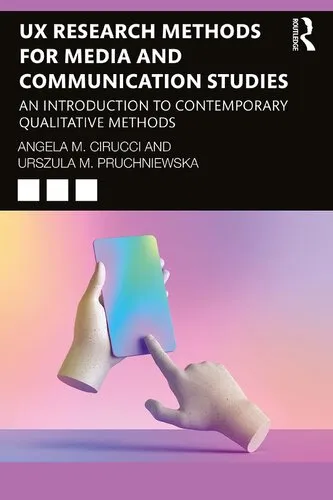
UX Research Methods for Media and Communication Studies: An Introduction to Contemporary Qualitative Methods
Angela M. Cirucci,Urszula M. Pruchniewska
2022
View book

Book guide and evaluation
Dennis A. Smith,Han van de Waterbeemd,Don K. Walker
0 reviews
Published
pages
views
Introduction to Pharmacokinetics and Metabolism in Drug Design, 2nd Edition Pharmacokinetics and metabolism are fundamental pillars in the process of drug discovery and development. Understanding how a drug behaves in the human body—how it is absorbed, distributed, metabol
Before you read
Pharmacokinetics and metabolism are fundamental pillars in the process of drug discovery and development. Understanding how a drug behaves in the human body—how it is absorbed, distributed, metabolized, and excreted (ADME)—is crucial for creating medicines that are both effective and safe. The second edition of Pharmacokinetics and Metabolism in Drug Design, part of the renowned Methods and Principles in Medicinal Chemistry series, provides readers with a comprehensive guide to this essential subject. Written by seasoned experts in the field, this book presents cutting-edge knowledge, practical guidance, and detailed insights into how pharmacokinetics and metabolism drive medicinal chemistry and drug development.
The second edition of this book is an extensively revised and updated work designed to address the evolving landscape of drug discovery and development. Across its chapters, the book covers theoretical principles, practical applications, and real-world insights, making it a must-read for professionals and researchers in medicinal chemistry, pharmacology, and related fields.
This edition provides a deep dive into the role of ADME in lead optimization, explains critical concepts such as bioavailability and clearance, and explores state-of-the-art methodologies for predicting pharmacokinetics and metabolism at an early stage in drug design. Techniques like in silico modeling and high-throughput screening are covered in detail. The integration of pharmacokinetics and metabolism with other disciplines, such as toxicology and drug safety, further underscores the interdisciplinary nature of modern medicinal chemistry.
The book also highlights emerging trends and technologies, such as personalized medicine and the use of artificial intelligence in pharmacokinetic modeling, providing a forward-looking perspective that prepares readers for the future of drug design. With numerous case studies and examples, the authors ensure that the theoretical knowledge is firmly grounded in practical application.
"Pharmacokinetics is not just the study of a drug's journey in the body, but a window into understanding its potential to heal or harm."
"The interplay between metabolism and pharmacokinetics dictates whether a drug will make it beyond the research laboratory to the bedside."
"Modern drug design demands that medicinal chemists not only create molecules but also guide their behavior in the biological world."
The importance of Pharmacokinetics and Metabolism in Drug Design lies in its ability to bridge the gap between theory and application in drug discovery. Pharmacokinetics and metabolism are no longer limited to academic exploration—they have become critical factors in the pharmaceutical industry, influencing decisions that impact time, cost, and success rates during drug development.
The second edition of this book equips scientists and researchers with the tools they need to predict and influence ADME behaviors, improving not only the efficacy of drug candidates but also their safety profiles. The inclusion of cutting-edge topics such as computational modeling and personalization in drug design makes this book particularly relevant in today's dynamic pharmaceutical landscape.
Moreover, the combination of theoretical foundations with practical examples ensures that readers can apply these concepts directly to their own work. This makes the book an invaluable resource for researchers, students, and professionals aiming to make a meaningful impact in the field of medicinal chemistry and pharmacology.
Your question is answered in the context of this title and author. Each answer uses 2 points.
0 reviews, 4.5 average out of 5
Sign in to publish a review.
Ask a focused question and learn from the community.
Related references that continue this learning path.
Angela M. Cirucci,Urszula M. Pruchniewska
Grebenikov E.,Mitropolsky Yu.A.,Ryabov Y.A.
P. L. Roe,J. J. Chattot