e-Development toward the Knowledge Economy : Leveraging Technology, Innovation and Entrepreneurship for 'Smart' Development
Elias G. Carayannis,Caroline M. Sipp
2006
View book
Book guide and evaluation
Goran Alderborn,Christer Nystrom
0 reviews
Published
pages
views
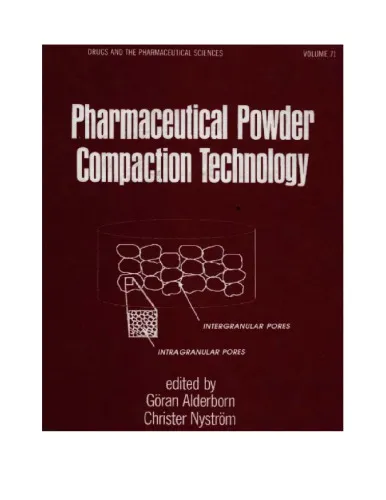
Welcome to the introduction of “Pharmaceutical Powder Compaction Technology (Drugs and the Pharmaceutical Sciences)”, a comprehensive resource that delves deeply into the principles, methodologies, and scientific advancements underpinning powder compaction tec
Before you read
Welcome to the introduction of “Pharmaceutical Powder Compaction Technology (Drugs and the Pharmaceutical Sciences)”, a comprehensive resource that delves deeply into the principles, methodologies, and scientific advancements underpinning powder compaction technology in the pharmaceutical industry. This book serves as a vital guide for pharmaceutical scientists, engineers, and researchers by delivering a thorough understanding of the science and mechanics behind powder compaction, an essential topic in drug formulation and production. Its practical and theoretical exploration makes it a cornerstone reference for both academic and industrial applications.
Powder compaction is one of the most fundamental yet complex processes in pharmaceutical manufacturing. This book methodically explores and demystifies this intricate technology through the integration of foundational theories, advanced research, and practical applications. The content ranges from the basic principles of compaction science to detailed analyses of powder behavior under compression.
The chapters cover critical topics such as the mechanics of compression, die-filling, the deformation of powders, and compaction instrumentation. The book also investigates the crucial role of material properties, particle size, and surface characteristics that influence powder compaction performance. Additionally, the work includes discussions on force-displacement measurements, lubrication, mathematical modeling, and scale-up considerations that bridge the gap between laboratory techniques and full-scale production processes.
The authors, Goran Alderborn and Christer Nystrom, expertly combine their diverse expertise to provide a scientific, yet reader-friendly, narrative. Their approach ensures that complex phenomena, such as stress relaxation, elastic recovery, and tablet variability, are demonstrated with clarity. The book emphasizes practical problem-solving, enabling readers to troubleshoot challenges related to tablet hardness, porosity, and dissolution rates during drug formulation.
"Understanding the forces at work during powder compression is the key to developing robust formulations and achieving consistency in drug delivery."
"The science of powder compaction transcends mere mechanics; it is an art form rooted in understanding material behavior at its core."
The relevance of this book stretches beyond its utility as a scientific reference. In an era where pharmaceutical demands are rising rapidly, the science of powder compaction remains vital for producing high-quality tablets, capsules, and dosage forms that meet rigorous regulatory requirements. This book equips professionals with the knowledge to excel in a field where technology is ever-evolving, and precision is paramount.
Furthermore, the interdisciplinary approach taken by the authors bridges gaps between engineering, material science, and pharmaceutical technology, fostering a holistic understanding of the subject. Whether you're a student, an academic researcher, or an industry professional, “Pharmaceutical Powder Compaction Technology” serves as a foundation for innovation and excellence.
This book is more than a textbook; it is a legacy of knowledge poised to guide the future of pharmaceutical manufacturing. By mastering its content, readers are positioned to make significant contributions to drug development, resulting in safer, more effective medications for the global population.
Your question is answered in the context of this title and author. Each answer uses 2 points.
0 reviews, 4.5 average out of 5
Sign in to publish a review.
Ask a focused question and learn from the community.
Related references that continue this learning path.
Elias G. Carayannis,Caroline M. Sipp

Irène Kilubi (auth.)