

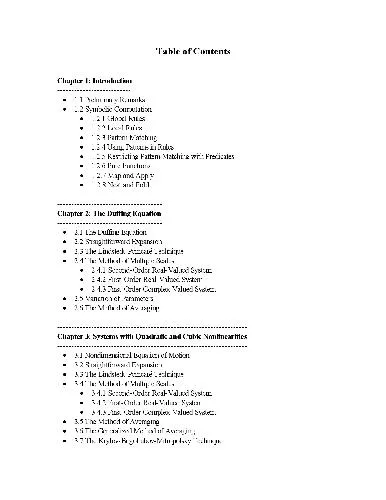
Book guide and evaluation
Perturbation methods with Mathematica
Nayfeh A.H.,Chin C.-M.
English
Beginner
Mathematics
4.3 / 5
0 reviews
1999
Published
346
pages
152
views
Introduction to Perturbation Methods with Mathematica Perturbation Methods with Mathematica is a comprehensive guide through the profound and intricate world of perturbation theory, coupled with modern computational techniques using the Mathematica software. Author
Before you read
What will you get from this book?
Introduction to Perturbation Methods with Mathematica
Perturbation Methods with Mathematica is a comprehensive guide through the profound and intricate world of perturbation theory, coupled with modern computational techniques using the Mathematica software. Authored by Nayfeh A.H. and Chin C.-M., this book holds its ground as a must-have for engineers, mathematicians, and scientists seeking to solve complex differential equations and nonlinear problems. It masterfully combines classical perturbation methods with the computational power of Mathematica, providing a seamless blend of theory and practice.
Aimed at both academic and professional audiences, this work simplifies traditionally abstract mathematical concepts. It demonstrates how perturbation methods can unravel solutions to problems that are otherwise challenging to approach directly. What sets this book apart is its dual focus: presenting perturbation theories in a clear and logical manner, while simultaneously utilizing Mathematica to simplify and solve examples in real-time.
Summary of the Book
At its core, the book is a toolkit for tackling problems that involve small or large parameters, often encountered in fields like fluid mechanics, nonlinear dynamics, elasticity, and electromagnetism. The perturbation methods discussed include regular perturbation methods, singular perturbation methods, and multiple-scale analysis. With Mathematica integrated into the presentation, readers can interactively explore these methods, check their calculations, and visualize results.
The book begins by introducing the fundamentals of perturbation theory, offering a robust theoretical foundation. It then builds upon this by scaling up to more advanced concepts, such as boundary layer theory and multi-time methods, which address singular problems. Each chapter is enriched with fully solved examples and step-by-step instructions on leveraging Mathematica to automate tedious calculations.
Complementing the mathematical rigor, Perturbation Methods with Mathematica places strong emphasis on practical implementation. Readers are invited to experiment with Mathematica notebooks to reinforce their understanding, gaining hands-on experience in using symbolic and numerical computation to solve mathematical problems that appear in a range of engineering and scientific disciplines.
Key Takeaways
- Comprehensive coverage of regular and singular perturbation methods.
- Detailed, real-world examples demonstrating the mathematical theories in action.
- Step-by-step tutorials on using Mathematica for solving problems interactively.
- Insight into practical applications of perturbation methods in diverse fields, such as fluid dynamics and structural mechanics.
- An effective combination of mathematical theory and computational tools.
- Invaluable to researchers, engineers, and students solving complex nonlinear systems.
Famous Quotes from the Book
"Perturbation methods bridge the gap between exact solutions and practical problem-solving, especially in cases where direct approaches fail to converge."
"Mathematica allows us to move beyond tedious arithmetic, enabling readers to focus on the essence of the perturbation methods themselves."
"In science and engineering, the utility of perturbation methods lies not in exactness, but in their ability to uncover the essential features of complex systems."
Why This Book Matters
In an era where computational tools are indispensable, Perturbation Methods with Mathematica provides a bridge between theoretical mathematics and practical applications. By integrating perturbation methods with symbolic computation, the book equips readers with potent methodologies to simplify, analyze, and solve daunting problems.
What sets this work apart is its accessibility. Many books on perturbation methods delve deeply into abstract theory without providing sufficient context or tools for practical implementation. This book alleviates such challenges by offering direct, hands-on examples with Mathematica, making complicated concepts digestible.
For researchers and students, this book provides a structured way to learn perturbation methods while gaining proficiency with a leading computational tool. For professionals in fields like engineering or applied physics, it narrows the gap between theory and practice, offering actionable insights into real-world problem-solving. Thus, Perturbation Methods with Mathematica stands out as an essential addition to any technical library.
Ask this book
Your question is answered in the context of this title and author. Each answer uses 2 points.
Sign in to ask the book assistant.
Reader reviews
0 reviews, 4.3 average out of 5
No reviews yet
If you have read this book, help the next reader with your experience.
Write a review
Sign in to publish a review.
Reader questions and answers
Ask a focused question and learn from the community.
Sign in to ask or answer a question.
No questions yet
Be the first to ask a clear, useful question.
What to read next
Related references that continue this learning path.


Modern Computer Vision with PyTorch: A Practical Roadmap From Deep Learning Fundamentals to Advanced Applications and Generative AI, 2nd Edition
V Kishore Ayyadevara,Yeshwanth Reddy
2023
View book