Book guide and evaluation
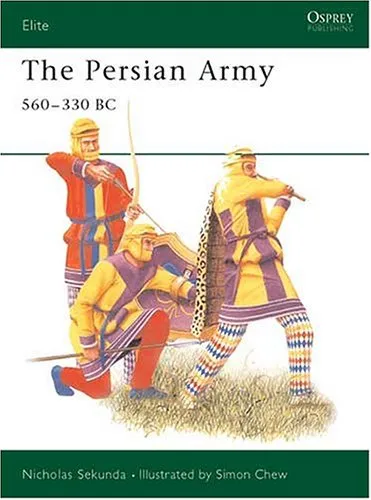
Persian Army 560-330 Bc
Nicholas Sekunda,Simon Chew
English
Intermediate
Historical
4.0 / 5
0 reviews
0
Published
67
pages
590
views
Introduction to 'Persian Army 560-330 BC' The book "Persian Army 560-330 BC" offers an in-depth exploration into the military forces of the Persian Empire during the pivotal era marked by the ascendance and decline of one of history's greatest empires. Authored by Nicholas
Before you read
What will you get from this book?
Introduction to 'Persian Army 560-330 BC'
The book "Persian Army 560-330 BC" offers an in-depth exploration into the military forces of the Persian Empire during the pivotal era marked by the ascendance and decline of one of history's greatest empires. Authored by Nicholas Sekunda and Simon Chew, this book provides a comprehensive account of the Persian Army in the context of its historical significance, organizational structure, and the strategic methodologies that allowed it to become a formidable power across Asia, Africa, and into Europe.
Detailed Summary of the Book
This book captures the essence of the Achaemenid Empire's military might, dissecting its influences, innovations, and operations from 560 BC to the empire's demise in 330 BC. Sekunda and Chew meticulously detail how the Persian Army, renowned for its engineering feats, logistical mastery, and diverse composition, was more than just a battlefield force – it was a central pillar of the Persian imperial structure. The narrative highlights the key reforms introduced under the reigns of notable emperors such as Cyrus the Great, Darius the Great, and Xerxes. The text also examines the administrative mechanisms, ranks, and strategic doctrines that contributed to the army's successes and failures.
Key Takeaways
- The Persian Army was instrumental in establishing one of the largest empires in history, providing a template for military strategy and organization.
- Diversity within the army was pivotal; troops were drawn from all corners of the empire, each bringing their distinctive skills and combat tactics.
- The Persian approach to warfare extended beyond the battlefield, incorporating diplomacy, infrastructure, and psychological strategies.
- The eventual downfall of the Persian military can be attributed to internal strife, overextension, and the lack of innovation against better-organized forces like Alexander the Great's Macedonian army.
Famous Quotes from the Book
"The Persian Army was a tapestry of cultures, echoing the vast expanse of an empire that stretched from the Indus Valley to the fringes of Greece."
"In the heart of Persia's military machine lay an unmatched logistical prowess; a triumph of organization over chaos."
Why This Book Matters
"Persian Army 560-330 BC" is not just a historical recount but a deep insight into the mechanics of one of history's great armies, providing readers with a richer understanding of ancient warfare dynamics. It encapsulates the essence of Persian culture and governance, showing how these elements combined to forge a military legacy that would be studied and admired by many succeeding generations. The book serves as a crucial reference for historians, military enthusiasts, and anyone interested in the cultural and tactical sophistication of the ancient world. By studying the Persian Army, one gains valuable lessons on the impact of leadership, innovation, and the integration of diverse cultural practices into a coherent, effective force.
Audio introductions
Persian Summary
Ask this book
Your question is answered in the context of this title and author. Each answer uses 2 points.
Sign in to ask the book assistant.
Reader reviews
0 reviews, 4.0 average out of 5
No reviews yet
If you have read this book, help the next reader with your experience.
Write a review
Sign in to publish a review.
Reader questions and answers
Ask a focused question and learn from the community.
Sign in to ask or answer a question.
No questions yet
Be the first to ask a clear, useful question.
What to read next
Related references that continue this learning path.